
Xinyan Robotics Puts Home Companion Bubbo on Sale as X-Era Open-Sources E0.5 World-Action Model
Xinyan Robotics puts its Bubbo 1 home companion on sale at RMB 9,499, X-Era AI open-sources the E0.5 world-action model, and the US flags robot imports.
Nvdium Tech | October 30, 2026
Xinyan Robotics launches Bubbo 1 home companion at RMB 9,499
Xinyan Robotics unveiled its first product, the embodied home companion Bubbo 1, in Beijing on October 29 and began selling it through JD.com and other official channels the same day. It costs RMB 9,499, with the first 1,000 buyers paying RMB 7,999. Bubbo runs the company's own Bubbo OS, recognizes each member of a household and keeps track of the relationships between them, and is aimed at keeping older people company and engaging children. It carries 26 sensors of 13 types, has six degrees of freedom and two expression screens, offers non-medical, camera-based heart-rate detection, and can share data with Cece smart rings. It is bilingual by default and uses a tiered dialogue system that pitches replies to what each user can take in. Xinyan was founded in 2025, and its first mass-produced Bubbo came off the line in mid-August. At the launch the company also announced strategic partnerships with JD Retail's intelligent robotics unit, Ingram Micro China, Beijing Shoucheng Robotics and others.
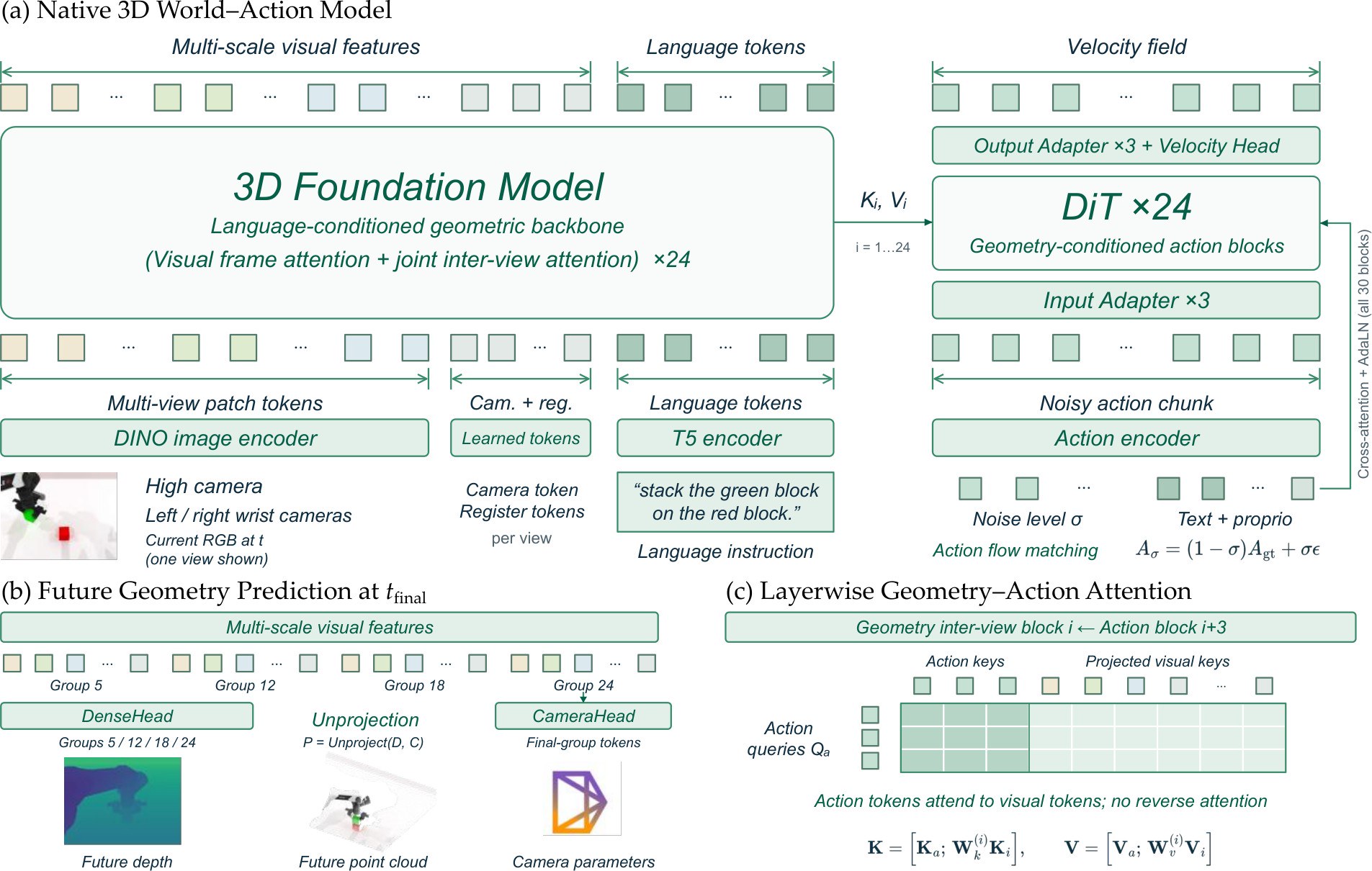
X-Era AI open-sources its 4D world-action model E0.5
X-Era AI has open-sourced E0.5, a world-action model, releasing the paper, project page and code together. E0.5 uses 3D geometry as its backbone and builds prediction of future 3D geometry directly into action learning. It handles spatial modeling and physical modeling separately, which helps it capture continuous changes such as contact, friction and deformation. On top of a 3D foundation model, it was further pretrained on about 160,000 real robot trajectories from AgiBotWorld-Beta. On the AgileX Piper dual-arm robot and the Zerith H1 humanoid, E0.5 reached average in-distribution success rates of 96.7% and 100%, and overall averages of 85.0% and 88.3% across in- and out-of-distribution settings. That is 13.3 and 26.7 percentage points above π0.5. The tasks were returning a mouse to its spot, packing a charger together with its cable, and clearing trash. On out-of-distribution multi-object trash clearing, the H1's success rate rose from 20% to 80%.
Bleu Robotics raises €5 million pre-seed round
Paris-based Bleu Robotics has raised a €5 million pre-seed round to grow its team and take its software into more industries:
- Co-leads: Contrarian Ventures, OVNI Capital
- Participants: Kvanted, WEPA Ventures, Motier Ventures, Charlie Songhurst
Bleu builds AI models for industrial humanoid robots. Instead of an end-to-end model, it uses abductive learning, inferring a task's goal and constraints from operator demonstrations, so a robot can learn a new task from as few as ten demonstrations while keeping the explainability that industrial safety requires. The software works with any humanoid platform, and operators teach tasks at the workstation with handheld gripper training devices, without coding. The company aims to cut the full humanoid deployment process to an hour or less. It was founded in December 2025 by Benoît Berkoukchi, Jean-Baptiste Mouret and Serena Ivaldi: two INRIA researchers and a former Renault manufacturing manager.
US declares robot imports a national security threat but holds off on tariffs
President Donald Trump signed a proclamation on October 28 under Section 232 of the Trade Expansion Act of 1962, finding that imports of robotics, industrial machinery and their parts threaten US national security. The proclamation imposes no immediate tariffs. Instead, it directs the Commerce Department and the US Trade Representative to negotiate with trading partners and report back within 180 days. If talks fail or an agreement proves ineffective, the president may consider tariffs, quotas, fees and a program to encourage investment in US production. The White House says the US produces less robotics and industrial equipment than it consumes and relies on imports for most types. Existing Section 232 tariffs on steel, aluminum and copper are unchanged.