OpenAI Private Intelligence Puts Frontier AI on Sensitive Work
OpenAI unveils Private Intelligence, bundling zero data retention, confidential-computing Private Inference in preview, data ownership and agent controls.
"Privacy should advance as fast as intelligence." With that line, OpenAI on October 30 introduced OpenAI Private Intelligence, a framework that gives businesses stronger control over their data while they use its most capable models. OpenAI says it is building the protections in close collaboration with some of its largest customers.
Private Intelligence is less a single product than a clearly packaged promise with four layers. Access restrictions: OpenAI sets strict limits on its own access to business content and offers zero data retention (ZDR) and Private Inference for eligible workflows. Data ownership: customers own their inputs and outputs. Agent actions: businesses decide what agents can access, which tools and actions they can use, and when a human must approve. Data security: encryption, strict access controls and ongoing threat detection.
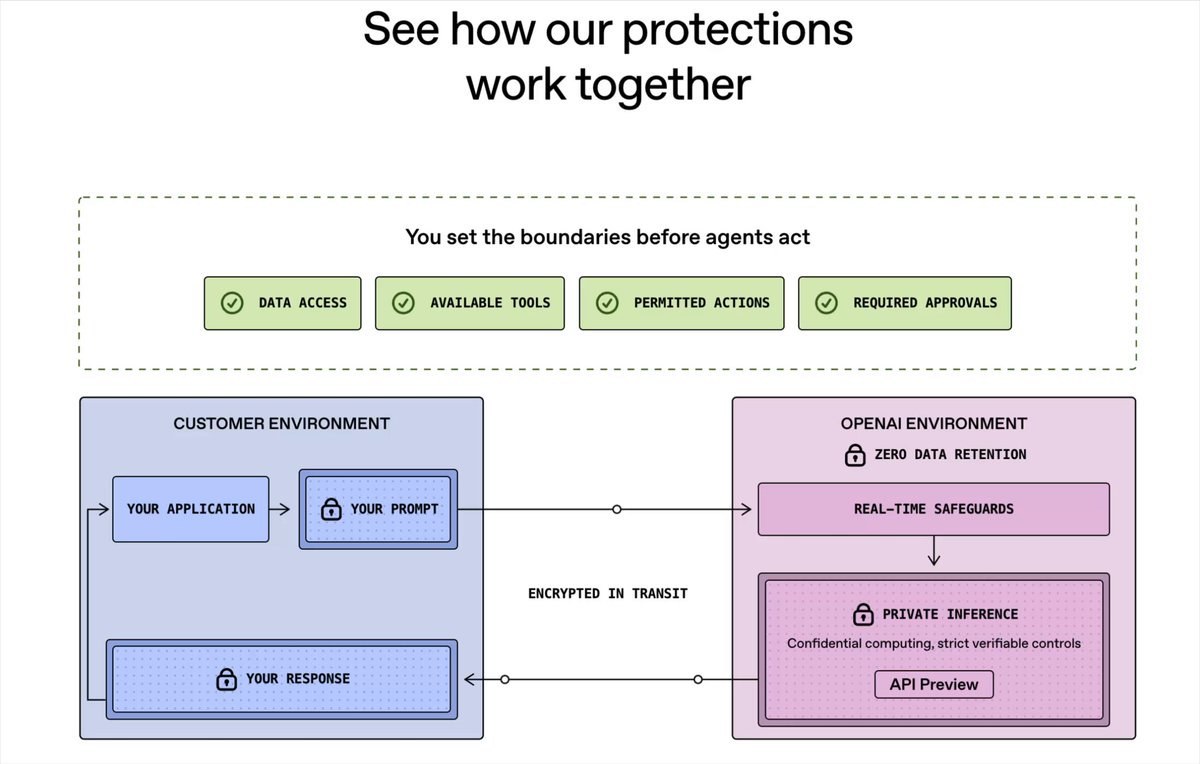
The piece to watch is Private Inference. In OpenAI's diagram, an encrypted request passes through real-time safeguards into a confidential-computing environment with "strict verifiable controls," currently offered as an API preview. That is OpenAI starting to answer "will you see my data?" with hardware isolation rather than contract language alone. Apple told a similar story with Private Cloud Compute; now the idea is moving into the enterprise model market.
The timing makes sense. Enterprise AI has shifted from chat assistants to agents that touch contracts, finance records, patient files and codebases. When the data boundary blurs, legal and security teams stop projects cold. Writing agent permissions and approval checkpoints into a privacy framework is really about clearing procurement hurdles for agents at scale. Add SOC 2 Type 2, ISO certifications, HIPAA BAAs and FedRAMP for government offerings, and the pitch is plainly aimed at CIOs and compliance officers.
How much weight "verifiable" carries will depend on details still to come: what third-party auditors can inspect, and whether customers can check remote attestation themselves. Those answers decide whether Private Inference is a label or a moat. But the direction is clear. The frontier race is widening from who is smartest to who is most trustworthy, and trust is exactly what enterprises pay a premium for.