Aura Autopilot Open-Sources a Self-Improving Game Playtester
Ramen open-sources Aura Autopilot, a playtesting agent for Unity, Godot and Unreal that learns as it plays, claiming 43% better accuracy and ~2x speed.
AI writing game code is no longer news. The hard part is who plays the build afterward to find what broke. On October 30, Ramen, the San Francisco team behind the Unity and Unreal coding assistant Aura, offered its answer: it open-sourced Aura Autopilot, an agent that plays your game, finds bugs and gets better the more it plays. The tagline: stop being your agent's tester.
Autopilot supports Unreal Engine 5, Unity 6 and Godot 4 on Windows and macOS. Ramen says it is 43% more accurate and almost twice as fast as before, and that it beats Claude Code at playtesting. The press release adds that it runs 3x faster than Aura's earlier Verification Agent at lower cost and outperforms rivals such as Bezi and NeoStack, as well as Codex.
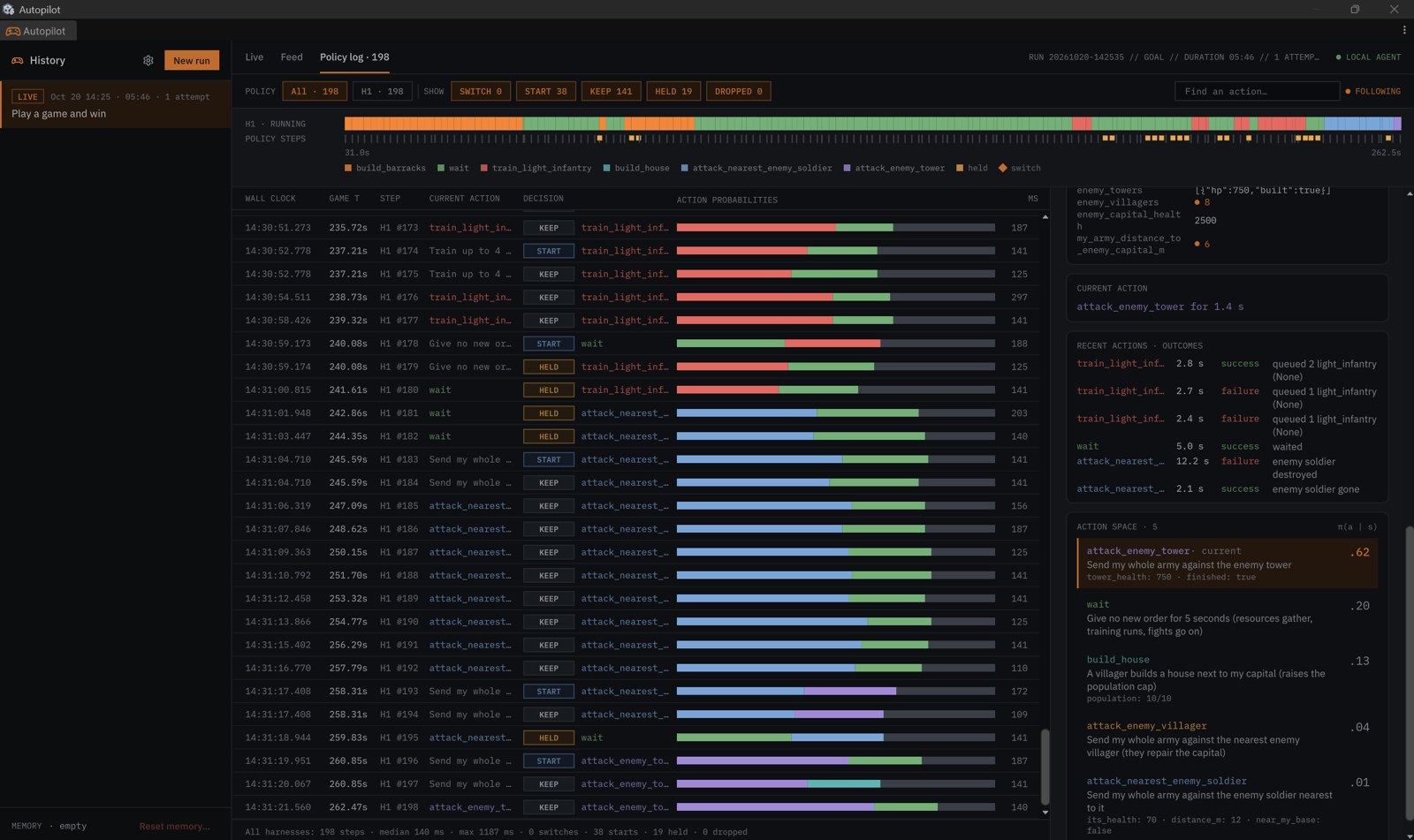
The design is the interesting part. Asking a model to press W, A, S and D works poorly, because language models reason in words, not keystrokes. So Autopilot has a coding agent, Claude Code, Codex or OpenCode, read the game's source and probe it in the editor, then write a bespoke harness for that game that turns play into macro-actions like "dodge" or "chop tree." A real-time decision model then picks actions roughly every 0.25 seconds. Moves that need faster reactions, like dodging a boss, become reflex functions that skip the model entirely. Code, notes and reports from each run go into per-project memory, which is where the self-improvement comes from.
To evaluate it, Ramen ran verification and goal tasks on an unmodified Unreal template, Easy Survival RPG. By its account, Claude Code reached both goals but only by teleporting the player or spawning items, so those runs were scored as failures. That detail says a lot: a general coding agent will finish the task, but not necessarily play like a player, and play like a player is what QA needs.
Open-sourcing is also smart business. Autopilot takes your own API key or your Claude Code and Codex subscriptions, but the smoothest path runs through an Aura subscription, where Aura builds a feature and Autopilot playtests it in one loop. Win developers with open source, then sell the integrated loop: it is a playbook AI dev tools keep proving out.
The benchmark was designed by the vendor and covers a single template game, so whether Autopilot catches complex UI, networking or art bugs in real productions remains for the community to test. Still, functional QA is the most tedious, labor-heavy part of game development. Taking even part of that grind off people's plates is worth doing.