
Seedream 5.5: 100-Round Edits, Native RGBA, 0.4% Severe Text Errors
ByteDance Seedream 5.5: 100 stable edit rounds, pixel-locked unedited regions, native RGBA, 0.4% severe text errors—but trails Nano Banana 2.1 on i2i realism.
Edit the same image 100 times, and the parts you didn't touch stay pixel-identical. That's the bet ByteDance's Seed team placed on Seedream 5.5, released November 9. Raw image quality no longer separates the top image models, so ByteDance went after the most painful step in production work: revisions.
Anyone who has iterated on product shots or posters knows the failure mode. Rounds one through three look fine. By round six, skin tones turn gray, backgrounds drift in color, and small objects like rings and eyeglass frames quietly warp. Seedream 5.5 claims pixel-level preservation of unedited regions, no color shift, and far less detail loss across successive edits, holding up for 100 rounds. In ByteDance's demo, one subject swaps hairstyle, glasses, outfit, background and tabletop props round after round, and the ring and frames stay sharp at the end.
Three upgrades, and transparency is the practical one
- Stable multi-turn editing: unedited regions locked at the pixel level, 100 consecutive edit rounds
- Native RGBA output: full and partial transparency with an alpha channel, clean hair and sheer-fabric edges, no cutout step
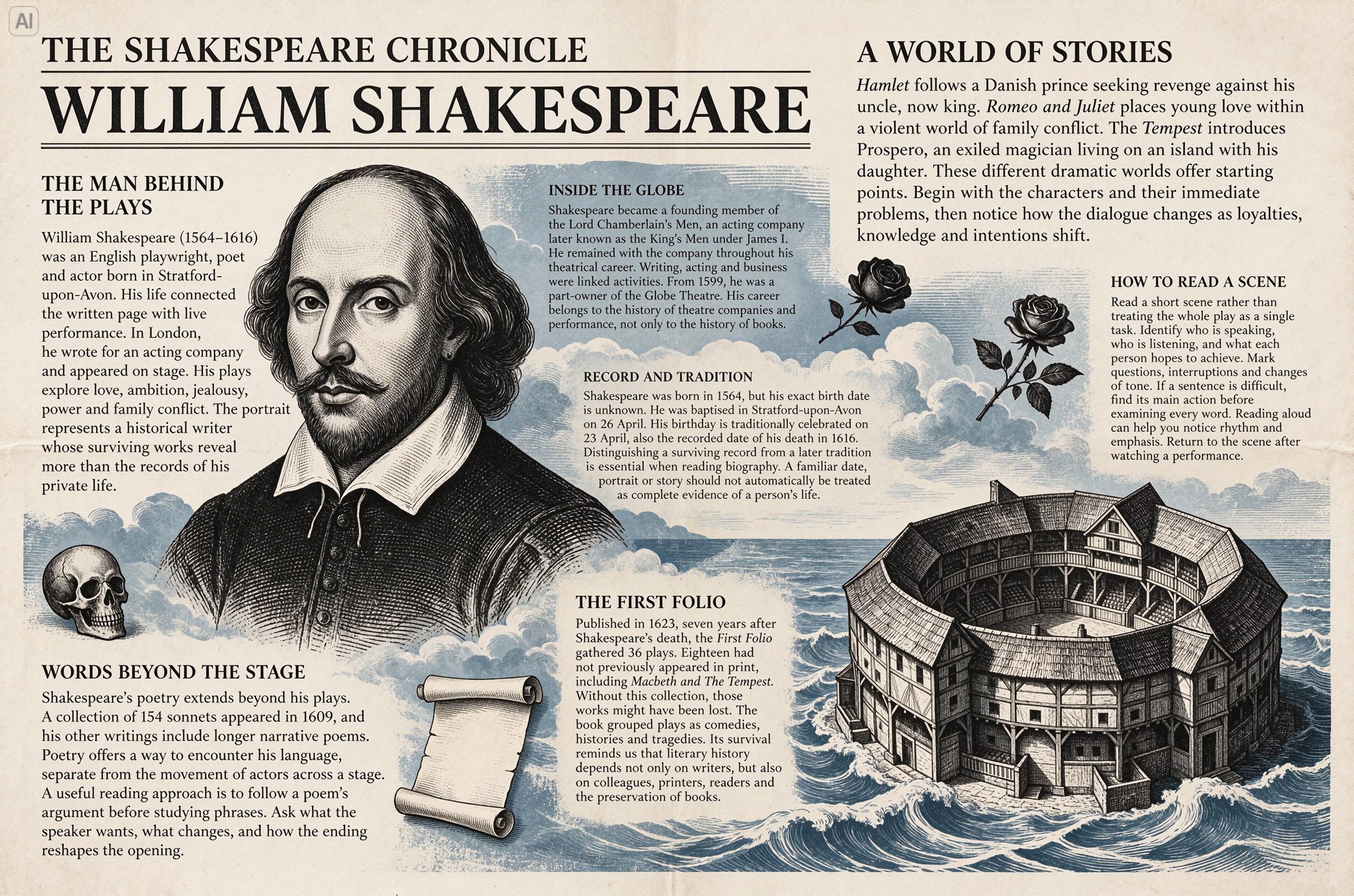
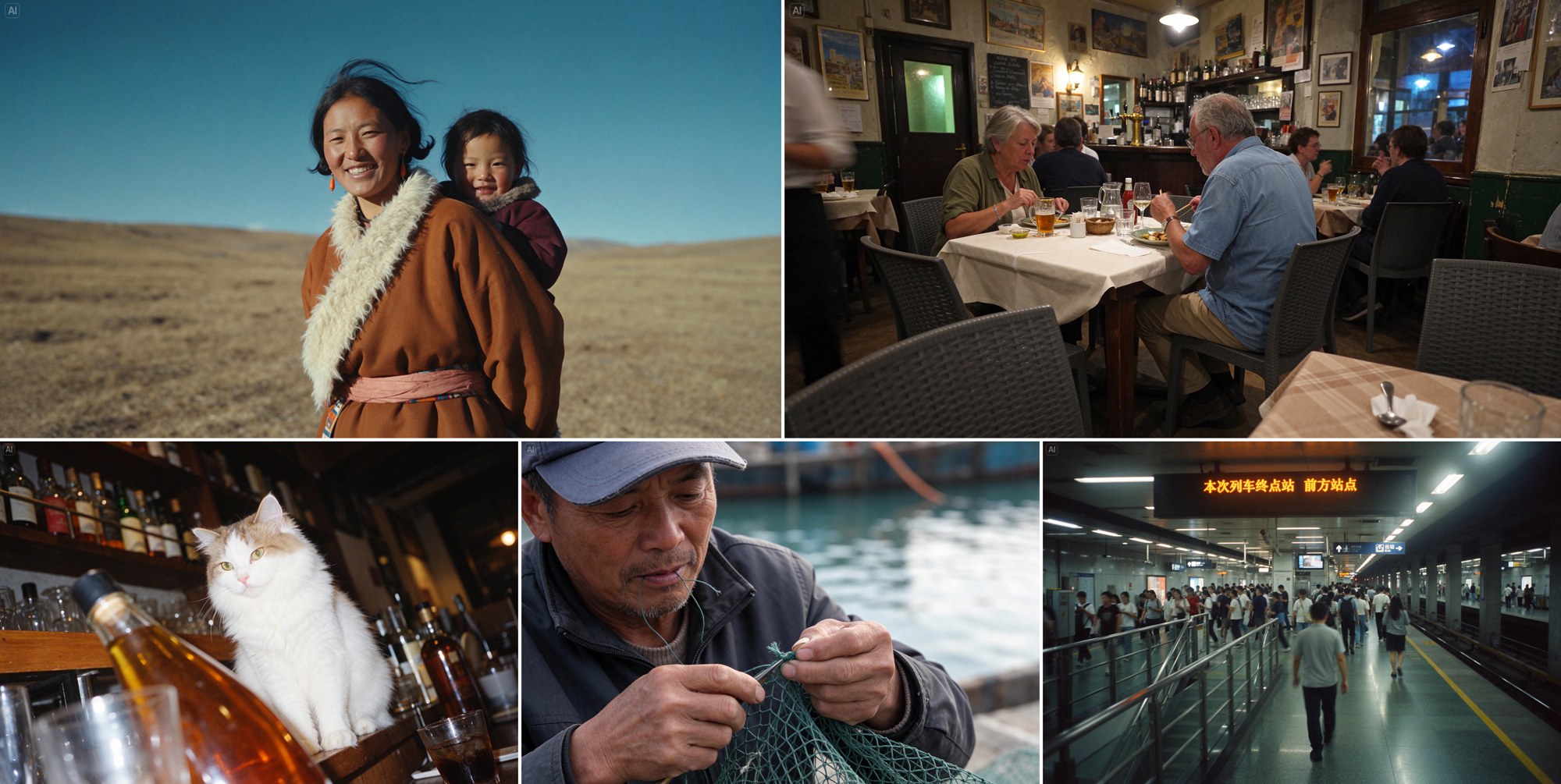
- Realism and small text: more natural lighting, materials and skin, less "plastic" gloss and overexposure; much better complex glyphs and dense small type
RGBA is the one people will underrate. Generate, cut out, clean edges used to be three steps. Now it's one, and stickers, layered characters and sprite sequences drop straight into a compositor. For e-commerce and game-asset teams, that saves more labor than a few points of image quality.
The comparison: a clear win over GPT Image, a close fight with Nano Banana
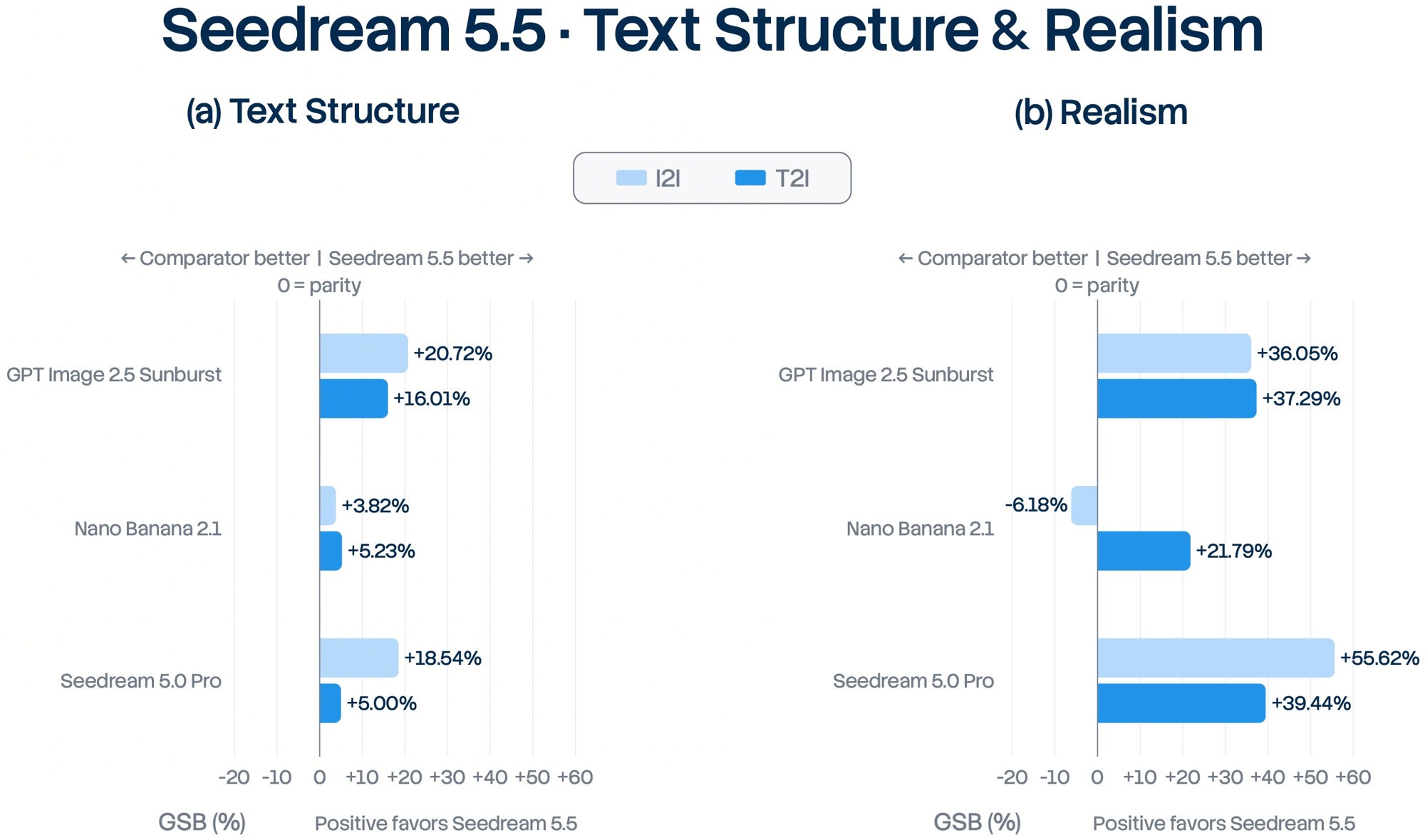
ByteDance used blind expert GSB (Good/Same/Bad) preference scores, positive meaning raters preferred Seedream 5.5, across text-to-image (T2I) and image-to-image (I2I):
| Rival | Text structure T2I | Text structure I2I | Realism T2I | Realism I2I |
|---|---|---|---|---|
| GPT Image 2.5 Sunburst | +16.01% | +20.72% | +37.29% | +36.05% |
| Nano Banana 2.1 | +5.23% | +3.82% | +21.79% | −6.18% |
| Seedream 5.0 Pro | +5.00% | +18.54% | +39.44% | +55.62% |
The headline "+55.62%" is against ByteDance's own previous model, not a rival. The lead over GPT Image 2.5 Sunburst is real, above 36% on both realism tasks. Against Nano Banana 2.1, the text-structure edge is only 4 to 5 points, and I2I realism is actually behind by 6.18%. It's the only negative cell in ByteDance's own chart, and it sums up the field: when you start from a real photo and edit it, Google still has a slight edge.
Also worth noting: the OpenAI comparison is GPT Image 2.5 Sunburst, not the newer 2.6.
Text rendering: 0.4% severe errors
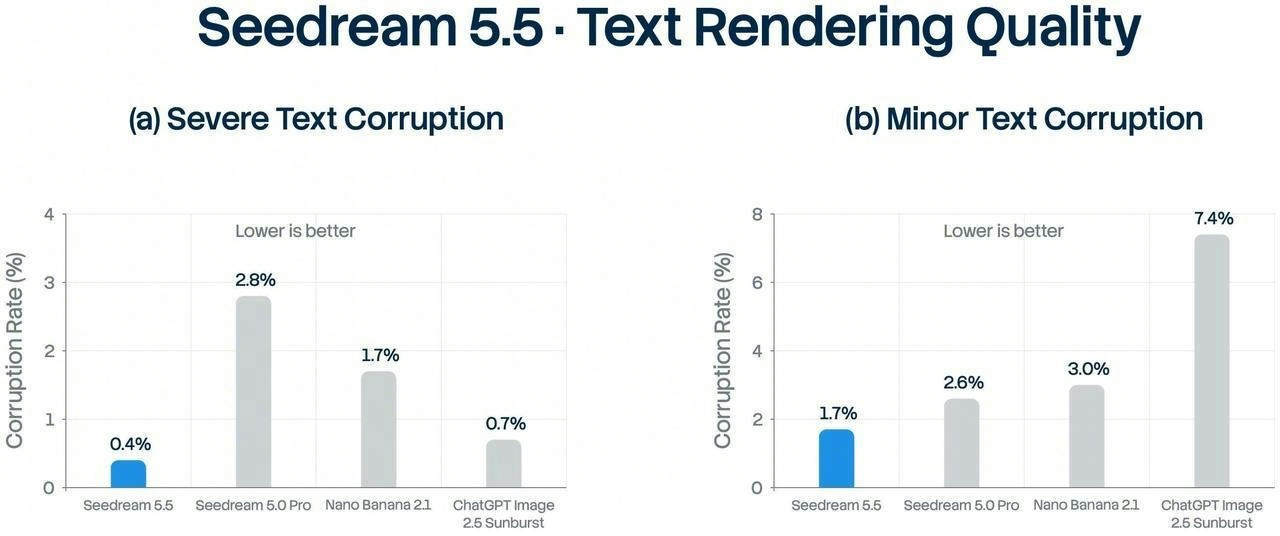
On a mixed Chinese-English test set that includes densely packed small text, Seedream 5.5's severe text corruption rate is 0.4% and its minor rate 1.7%. On the same chart, Seedream 5.0 Pro sits at 2.8% and 2.6%, Nano Banana 2.1 at 1.7% and 3.0%, and ChatGPT Image 2.5 Sunburst at 0.7% and 7.4%. Seedream 5.5 is lowest on both.
ByteDance also had senior raters score six production categories: e-commerce, marketing, film and TV, gaming, office and fashion. Version 5.5 beats 5.0 Pro on usability and quality in all six, and usability more than doubles in film/TV and office. Office means infographics, slide visuals and posters, where one garbled word kills the whole image, so a doubled usability rate matters more than a higher MOS.
Pricing: about 60% cheaper than the last generation
In China, the model runs on Volcano Engine Ark with the same two-part billing (input image plus output image), and text tokens are free. Editing a 2K square image costs about ¥0.28, roughly 60% less than Seedream 5.0 Pro, with generation about 40% faster. Internationally, BytePlus lists it from $0.02 per image.
Consumer access is rolling out through Dreamina (Jimeng in China), CapCut and Doubao. Dreamina launched a promo alongside it: 7 days of unlimited use for everyone, 30 days for Basic and higher subscribers.
Easy misreads
All comparison data is ByteDance's own. GSB and usability scores came from raters on ByteDance's MagicArena platform. The prompt set isn't public, and no third-party arena has scored the model yet.
"100 rounds" is a stability ceiling, not a quality promise. It means no obvious degradation over 100 edits, not that round 100 looks identical to round 1.
The API model ID and maximum resolution aren't spelled out yet. The ¥0.28 figure is a 2K square editing example, not a resolution cap.
Image generation is no longer about one jaw-dropping render. It's about whether version twenty is still usable. Seedream 5.5 pulls clearly ahead of GPT Image 2.5 on text and edit stability, but it hasn't caught Nano Banana on photo-based realism. The next thing to watch is how fast Nano Banana 3 and OpenAI's next image model answer.