Skild AI Open-Sources Steel Physics Solver as Robbyant Releases LingBot-Touch Tactile Model
Skild AI open-sources the Steel physics solver for Newton with Nvidia, as Robbyant releases LingBot-Touch.
Nvdium Tech | November 10, 2026
Skild AI open-sources the Steel physics solver
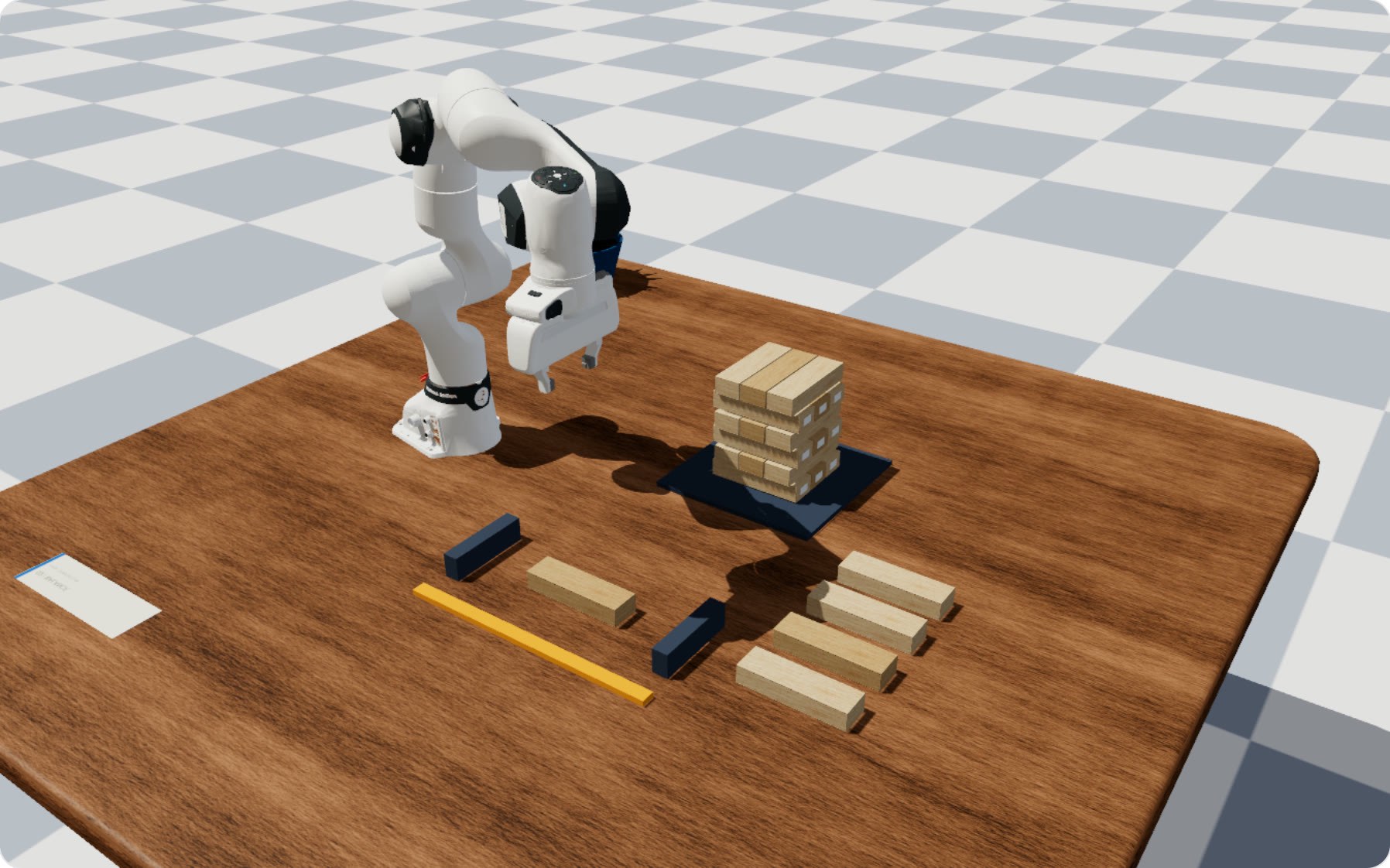
Skild AI, the robot foundation model company, has released Steel, a GPU-accelerated rigid-body dynamics solver built with Nvidia, as open source under the Apache 2.0 license. Steel is now part of the open-source Newton physics engine, available as the experimental newton.solvers.SolverSteel in the Newton 1.8 release candidate, and is meant for training robot policies in Nvidia Isaac Lab. Skild also released a WebGPU version that runs demo scenes directly in a browser.
Steel targets the cost of simulating manipulation. GPU simulators are good at cloning one robot in one scene thousands of times, which drove progress in locomotion. But an arm reaching through free space, a dexterous hand turning a cube and a gripper digging through a cluttered bin have very different joint counts and contacts, and running them together forces conventional engines to pad simpler scenes, wasting compute and memory. Steel organizes dynamics and constraints per environment, groups robots with similar joint counts, and sizes the contact-solving work to what each scene needs at each step.
On a single RTX PRO 6000 Blackwell GPU, Skild measured Steel at 3.8 times PhysX's simulation throughput on average across 20 single-task benchmarks, faster on 19 of them, and about 1.3 times MuJoCo Warp. On the 23-joint Kuka–Allegro lift task it reached 6.7 times PhysX. On batches mixing 5 to 20 task types, including humanoids, quadrupeds, arms and dexterous hands, Steel's peak throughput was 9.2 to 13 times that of PhysX. With 20 task types, it hit 3.9 million environment steps per second across 245,760 environments, against 300,000 for PhysX across 61,440. At a matched 61,440 environments, Steel was 12 times faster and used about 62% less GPU memory, roughly 11 GiB versus 29 GiB. The figures cover physics stepping only, not full policy training. Steel can also serve as the rigid-body side of Newton's coupled simulations with cables, cloth, sand and soft bodies, and offers an experimental differentiable mode. Skild says its next step is to study what happens to robot capabilities when the diversity of simulated experience grows along with its volume.
Robbyant open-sources the LingBot-Touch tactile model
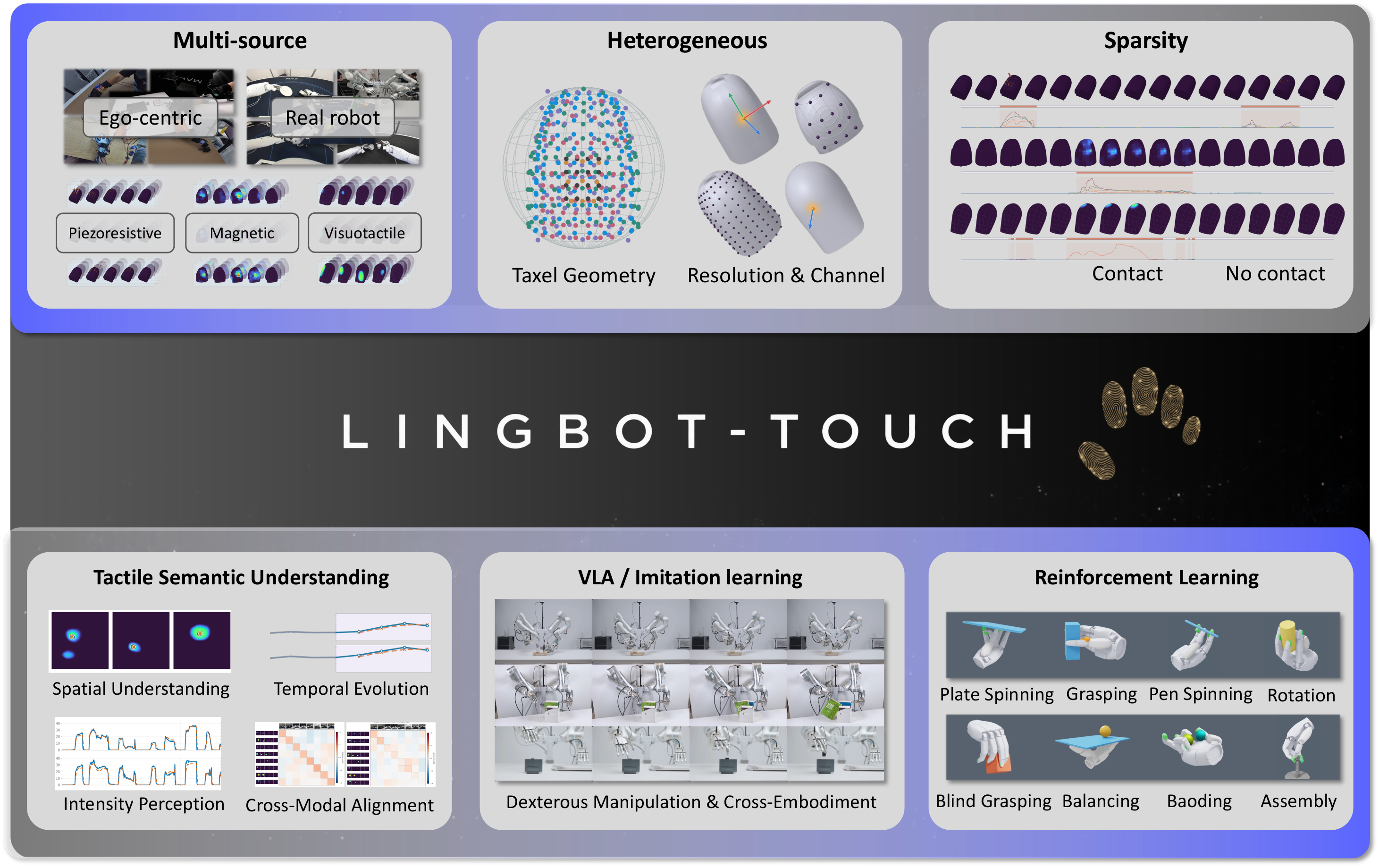
Robbyant, Ant Group's embodied AI company, has released LingBot-Touch, an open-source tactile foundation model, along with its technical report, code and Tiny and Small model weights under the Apache 2.0 license.
LingBot-Touch is built on a JEPA architecture and pretrained on nearly 5,000 hours of real tactile data collected from data gloves and robot hands. Tactile sensors from different makers work on different principles and produce very different signals, so the model uses separate tokenizers to turn magnetic, piezoresistive and visuotactile readings into a common set of tokens, then feeds them to a shared Transformer that learns contact structure and how it changes over time by predicting in latent space. Its features plug into downstream force-control and manipulation policies and transfer across sensors, dexterous hands, tasks and action models without extra training, including to sensors it never saw in training.
Robbyant evaluated the model on 26 real-robot tasks covering contact-heavy work such as force control and two-handed coordination, using dexterous hands including the Sharpa Wave and XHand1 and pairing them with several action models. Adding LingBot-Touch features raised success rates by 14 to 26 percentage points over vision alone. The tests also found that feeding raw tactile signals straight into a policy made results worse in 22 of 104 test groups, and switching to the pretrained features recovered most of those cases, a sign that touch data needs a shared representation before it can really help dexterous manipulation.