Rime Launches Prism, an RL-Customizable Voice Model

Rime's Prism is an end-to-end speech-to-speech model for enterprise voice agents.
It writes replies as text first, and the company says it can be tuned with RL.
Anyone who has called a support line knows voice AI's worst habit isn't a wrong answer but a long pause or a badly timed interruption. Rime Labs has launched Prism, an end-to-end speech-to-speech model for enterprises, built to respond more like a person.
Write first, speak second
Prism listens to the caller's audio and answers in audio, rather than transcribing, passing the text to a language model and synthesizing the result. It can still hear frustration in a voice, or a dog barking in the background.
Before it speaks, though, it writes out what it is about to say. Rime calls that text a checkpoint: a company's rules can read every word before it becomes speech, and block or rewrite it. Tool calls run in parallel with speech, so the model can say "let me check that" while the backend works, and there is no dead air.
Two speed claims
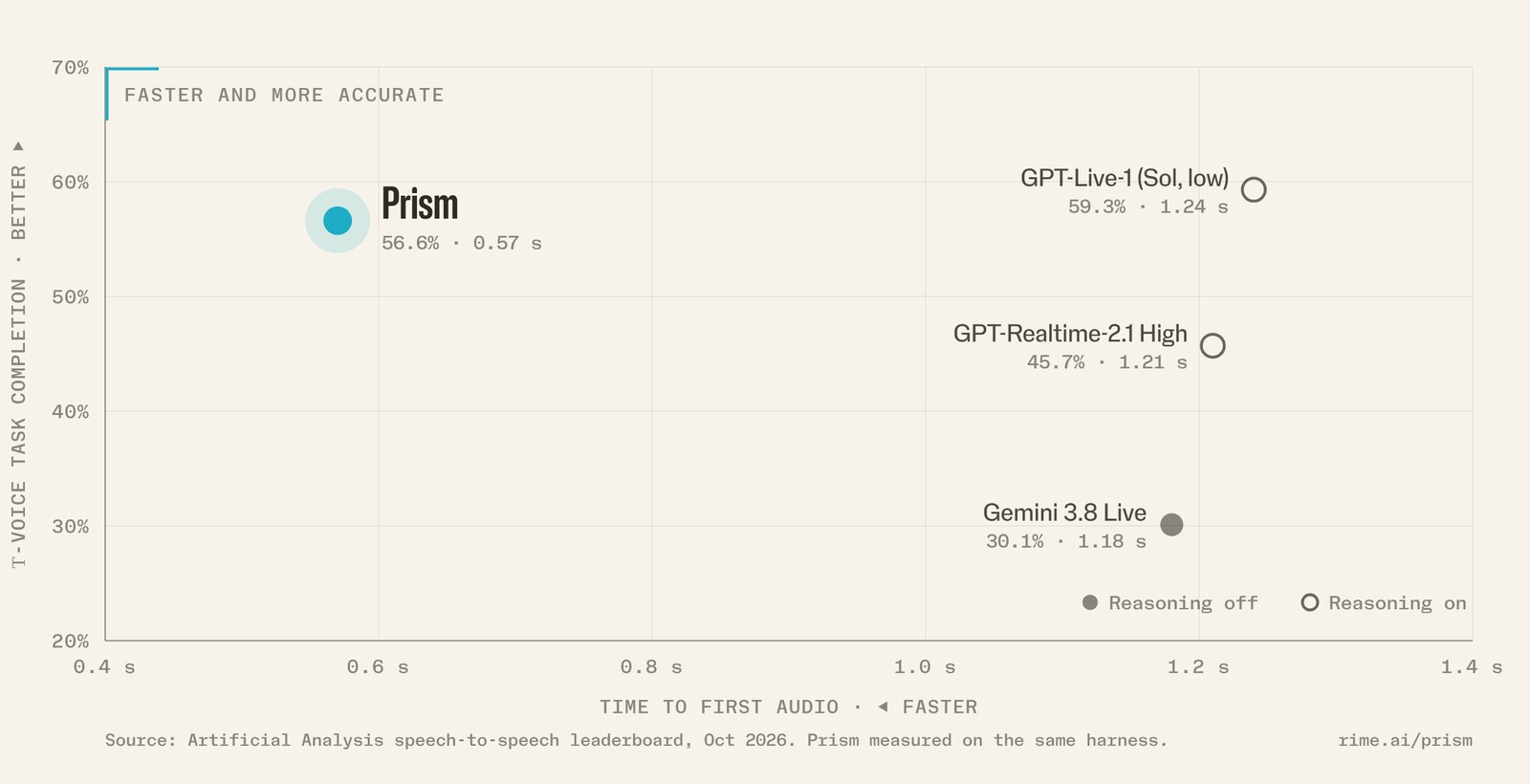
CEO Lily Clifford said on X that Prism responds in about 300ms, four times faster than OpenAI's GPT-Live. Rime's own launch post is more conservative: about 500ms, with first audio at 0.57 seconds, roughly half the wait of GPT-Live-1, GPT-Realtime-2.1 and Gemini 3.8 Live.
On quality, Rime ran Artificial Analysis's τ-Voice benchmark on the same harness, with no reasoning step before speaking. Prism scored 56.6. The company says that is 17 to 30 points above the non-reasoning realtime models from OpenAI and Google, and in telecom 82.5 versus 45.6 for GPT-Live-1. These are Rime's own runs, not a published leaderboard entry.
The real pitch: you can retrain it
A voice agent can't think before it speaks the way a text model can; reasoning blows the latency budget of a live call. Rime's conclusion: the intelligence in the weights is the intelligence you get, so better performance in your own domain means owning those weights.
The company calls Prism the first speech-to-speech model anyone can fine-tune. Its example: using 10 hours of production calls from ordering platform Revmo, Rime built a reinforcement-learning environment and trained a Prism on it. In 94% of cases the tuned model placed an order only after the caller said yes to "shall I place it?", versus 57% for the OpenAI model it was compared with. That is one customer and one behavior, closer to a proof of concept.
What to check before relying on it
Prism is English only for now, and the self-serve RL and supervised fine-tuning APIs are still being built with beta customers. Telephony also needs an extra bridge, since Prism doesn't accept or send G.711 audio directly.
Still, the idea is clear. Other realtime voice models are something you buy and use; Prism wants to be something you buy and then train, which appeals most to companies with huge call volumes and scripted workflows. Interested teams should test it on their own call recordings, watching time to first audio and completion rates on critical steps like ordering and identity checks.