DeepMind's AlphaProof Code Verifies Signal Down to Machine Code
DeepMind's AlphaProof Code verified libsignal down to machine code in four weeks with 6.5M Lean lines.
It covers one-to-one sessions and found no new bugs.
Roughly 6.5 million lines of machine-checked Lean, four weeks, and the target is libsignal, the Signal protocol's reference implementation. The proofs aren't about a design doc. They're about the compiled AArch64 binary. Google DeepMind unveiled AlphaProof Code today and says it's the first time anyone, with or without AI, has formally verified the production code of a widely deployed cryptographic protocol to this depth.
Get the framing right first: AlphaProof Code isn't a model you can call. It's a multi-agent verification harness. Human experts work with models to turn Signal's security goals into Lean specifications, and a human reviews every one. Then a team of Gemini Carbon-powered prover agents fills in the proofs, and a proof only counts once Lean's kernel checks it against the approved spec. The agents also audit their own work and flag about 1% of it for a second human look.
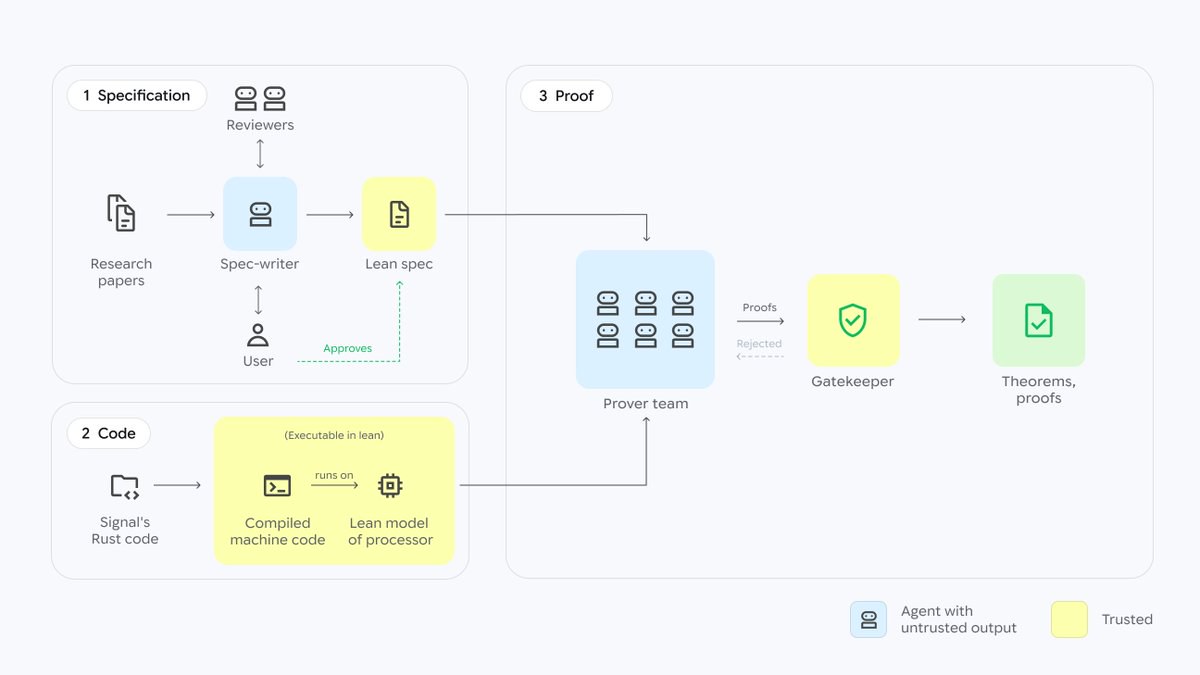
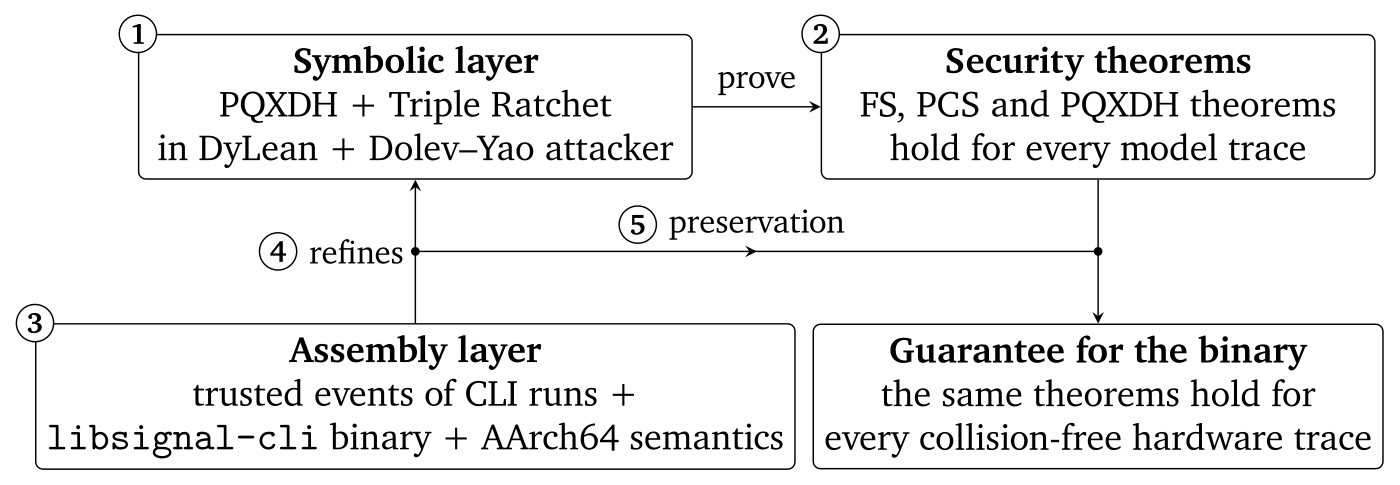
The proofs cover the post-quantum PQXDH handshake and the Triple Ratchet, establishing forward secrecy, authentication, post-compromise security and handshake secrecy. Two tracks run in parallel. The symbolic (Dolev–Yao) track even covers handshake secrecy against a future quantum attacker, while the computational track gives concrete bounds but only against classical adversaries.
The ratio is what matters. The verified libsignal code is about 560 KB, or around 140,000 AArch64 instructions, and the trusted base is only about 26,000 lines of specs plus AArch64 semantics. Most of the 6.5 million proof lines, about 5.3 million, go into the binary layer, with about 860,000 for the computational proof and 350,000 for the symbolic one. In other words, the "trust the compiler" assumption is gone: the guarantees land on the bytes that actually run on a phone.
The sanity check was blunt. The team put two real, long-fixed bugs back into an isolated build, and both times the system produced a machine-checked proof that the build was insecure. It found no new vulnerabilities in the current code.
Several readings are easy to get wrong. This is not "the whole Signal app is bug-free." The scope is one-to-one sessions in libsignal v0.105.4, group messaging is explicitly future work, and the primitives' security, Lean's kernel and some external routine contracts are all assumed. The "3 million lines" figure floating around doesn't match the paper, which puts it at about 6.5 million. WhatsApp, Messenger and Google Messages run variants of the protocol, so this result doesn't transfer to them automatically. And DeepMind hasn't said whether this becomes a product or what the compute bill was.
The direction is still unmistakable. Formal verification was always expensive because humans had to write the proofs. Now agents do the expensive part, and humans decide what has to be true. Signal CTO Ehren Kret says earlier verification covered much smaller slices of the code and that this significantly expands the scope. The specs and proofs are open at google-deepmind/code-verification.
Next up are group chats, more protocol stacks, and the banks and critical infrastructure that will pay for provable code. AI already writes code faster than humans can review it. AlphaProof Code's answer is to stop reviewing and start proving.