
Korea Opens Its First Humanoid Data Factory; Sazhi Intelligence Raises Hundreds of Millions of Yuan in Pre-B Round
KIMM opens Korea’s first humanoid data factory; Sazhi raises a Pre-B round; Lingchu robots trial at Li Ning logistics; NC AI unveils VAETKI Vision 3B.
Nvdium Tech | November 3, 2026
KIMM opens South Korea’s AI Humanoid Data Factory
On November 3, the Korea Institute of Machinery and Materials (KIMM) opened its AI Humanoid Data Factory in Daejeon, built together with the Electronics and Telecommunications Research Institute (ETRI). It is South Korea’s first facility dedicated to producing training data for two-legged humanoid robots. Spread across two floors and about 1,000 square meters, it currently runs 12 humanoids and plans to grow to 25. Operators teleoperate the robots through household and industrial tasks such as taking items out of a refrigerator, handling laundry, tidying a sofa and working the buttons and levers inside a car. The recorded motion and task data trains vision-language-action (VLA) models, which are loaded back onto the robots for testing, and the data from those runs flows back into training. At the opening, KIMM’s own humanoid KAIROS demonstrated precise object handling and whole-body motion imitation; KAIROS version 1 is due in April 2027. The factory will open to Korean companies, universities and research institutes in stages from late 2027. The project falls under the Ministry of Science and ICT’s K-Moonshot humanoid mission, and on August 27 the Ministry of Planning and Budget set aside 2.3 trillion won (about $1.7 billion) through 2030 for the humanoid industry, including purchases of 1,080 domestic humanoids and a goal of raising the local share of core parts from about 45% to 80%.
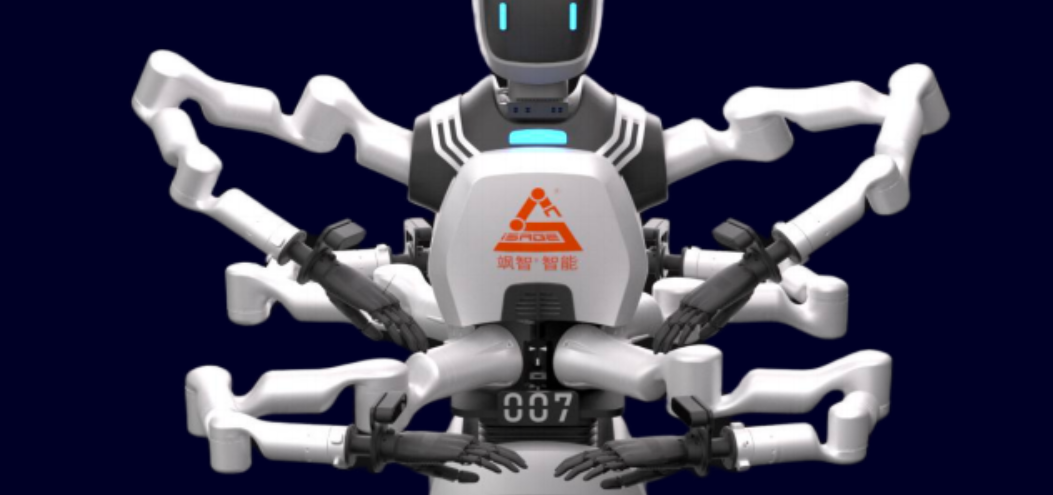
Sazhi Intelligence closes Pre-B round worth hundreds of millions of yuan
Shanghai-based industrial embodied-AI robot maker Sazhi Intelligence Technology announced on November 3 that it has completed a Pre-B round worth several hundred million yuan:
- Investors: Jiantou Investment, Nantong Investment Management and Cloud Capital (Yunqi Capital);
- Financial adviser: Index Capital;
- Use of funds: large-model R&D, iteration of its multi-arm robots, production-line expansion and overseas growth.
Founded in 2017, Sazhi is led by founder and CEO Zhang Jianzheng, who holds a PhD in mechanical engineering (intelligent robotics) from Shanghai Jiao Tong University and previously worked at Step Electric and FANUC. Its lineup spans single-, dual-, four- and six-arm robots. The new four-arm model runs four arms from one “brain” and doubles parallel efficiency over the previous generation, while the six-arm “Xuanjia” places pairs of arms at the front waist, back waist and shoulders so it can serve several surrounding production lines at once. The company works across 3C and semiconductors, automotive, energy, and food and pharmaceuticals, counts more than 50 Fortune Global 500 or listed companies as customers, expects business to roughly double this year and has more than 500 million yuan in overseas orders of intent. Its factory in Shanghai’s Maqiao area is running at full capacity, and Sazhi plans to expand the site to about four times its current size over the next three years.
Lingchu Intelligence robots begin trial operations at Li Ning’s East China logistics hub
Lingchu Intelligence and Hengyan Technology have jointly taken on a project at Li Ning’s East China smart logistics center, where Lingchu’s embodied robots, running its in-house models, have been deployed on site and entered trial operations, handling routine work and fulfilling paid commercial orders. The robots take on one of the hardest jobs in a footwear and apparel warehouse, picking into order boxes from totes where shoe boxes are mixed together, randomly oriented and partly hidden. They handle recognition, pose estimation, grasping and sorting, and push full order boxes out automatically. The system connects to the existing warehouse management system without major changes to the building. During the trial, the three teams will run stress tests and edge-case checks to raise picking success rates and long-run stability.
NC AI unveils VAETKI Vision 3B, a lightweight vision-language model for robots
South Korea’s NC AI on November 3 introduced VAETKI Vision 3B, an ultra-light vision-language model built to handle visual perception for robots and industrial equipment with limited onboard compute. The company plans to use it as a core component of vision-language-action models. VAETKI Vision 3B averaged 63.8 across the BLINK, ERIQ and ERQA robotics and spatial-understanding benchmarks, beating 4B- and 8B-parameter open models including Alibaba’s Qwen and Mistral’s Ministral in its standard, non-reasoning mode. For video it analyzes inter-frame relationships in 4-second, 8-frame chunks, helping it track fine robot movements and the paths of work objects. NC AI also fine-tuned a welding version, VAETKI Vision 3B Weld, which raised welding classification accuracy from 41.1 to 80.9, defect detection and state inference from 39.3 to 69.8, and recognition of weld positions and shapes from 5.3 to 72.5. The company plans to add reinforcement learning and deploy the model as a vision engine and VLA base across its ongoing physical AI projects.