
A runaway goat damaged cars and fled police. Now he’s found his herd.
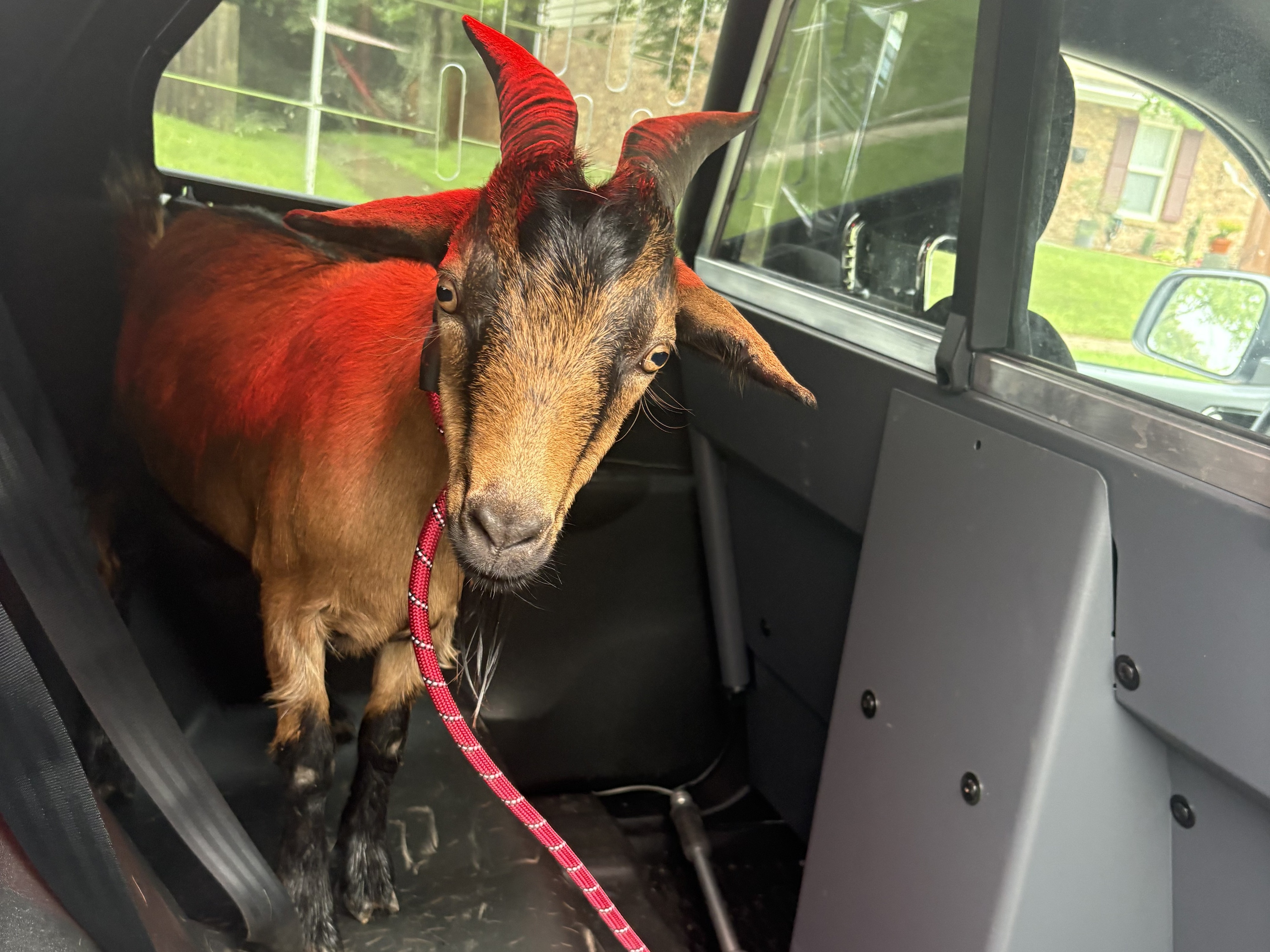
Officers on foot chased the goat through streets, yards and woods before catching him.
Officers on foot chased the goat through streets, yards and woods before catching him. For months, police in Ohio heard the same complaint: A runaway goat was jumping on top of parked cars, scratching and denting them.
But the suspect proved elusive. So when Dayton police got a call last month that the goat had escaped again and was roaming the streets, three officers raced to the scene to try to catch the culprit. The officers chased the goat on foot on a humid morning through suburban streets, yards and woods.
About 90 minutes and two miles later, an officer slipped a snare around the goat’s neck and triumphantly yelled: “Got the goat!” An officer then gently hoisted him into the back of a police car a few minutes later. The goat, named Cardio by officers because of the workout he gave them, was taken to the Humane Society of Greater Dayton.
Cardio, who is a year old and weighs about 35 pounds, wasn’t trying to live a life of crime, police said. He was following his species’ natural instinct to climb elevated surfaces that mimic the steep, rocky terrain their ancestors lived on. The shelter said they contacted Cardio’s owner, who decided to surrender him in hopes the goat, who Jones said had escaped at least seven times, would find a better home.
Police and the shelter said they didn’t know what type of property Cardio was living on, or whether it was a farm. At the shelter, the Oberhasli goat — a dairy breed that originated in Switzerland — ate pellets and lettuce out of employees’ hands. He seemed lonely, the shelter said, at times placing his forelegs on the wooden walls of his stall to look outside and bleat when he heard dogs barking.
The shelter wanted to find Cardio a home with goat companions and advertised him on social media on Sept. 16. “He’s looking for an appropriate goat home, potentially some animal friends, patient people willing to earn his trust, and, for everyone’s sake, a reasonable distance from parked cars,” the shelter wrote. “We got to go after him,” Keeton, 47, recalled thinking.
The farm where Keeton lives with her husband, Josh, takes in goats that are injured, abandoned, up for auction or slated to be slaughtered. Many of them visit schools and nursing homes, and participate in the farm’s goat yoga and cuddling events. Keeton submitted an adoption application and visited Cardio that afternoon, but said she was nervous the goat wouldn’t like her or would be aggressive.
She offered goat feed to Cardio, who walked over and ate out of her hands, which Keeton said “melted my heart.” “We’re going to be friends,” Keeton told Cardio. Keeton carried Cardio out of the shelter and placed him into the back seat of her truck that has the license plate “GOAT TRK” — goat truck.
At the farm, Cardio met a handful of his roughly 50 new goat neighbors — as well as a few geese and ducks. He quickly became attached to Eva, a 5-year-old Nigerian dwarf goat, and GarE, a 1-year-old Anglo-Nubian goat, Keeton said. Cardio has spent the past few days getting accustomed to the farm, where goats eat hay and forage for leaves, pine, apples and honeysuckle.
He now approaches Keeton when he sees her. Keeton hopes Cardio will become so trusting that he will cuddle with people and comfort students and nursing home residents, but she doesn’t want to rush him. “The last thing we want,” Keeton said, “is him vandalizing somebody else’s car.”