BotGauge Hits Product Hunt as a Trust Layer for Agents
BotGauge is a trust layer for AI agents: adaptive red teaming, full traces, and failures turned into regression evals.
Now on Product Hunt.
Agents no longer just chat. They call tools, change orders, and touch real data—and they fail in ways unit tests miss. Swap the model or tweak a system prompt and the path can change completely. BotGauge positions itself as a trust layer: attack the agent before users do, then turn every real break into a regression check that ships with every release.
Break it first, then freeze the failure
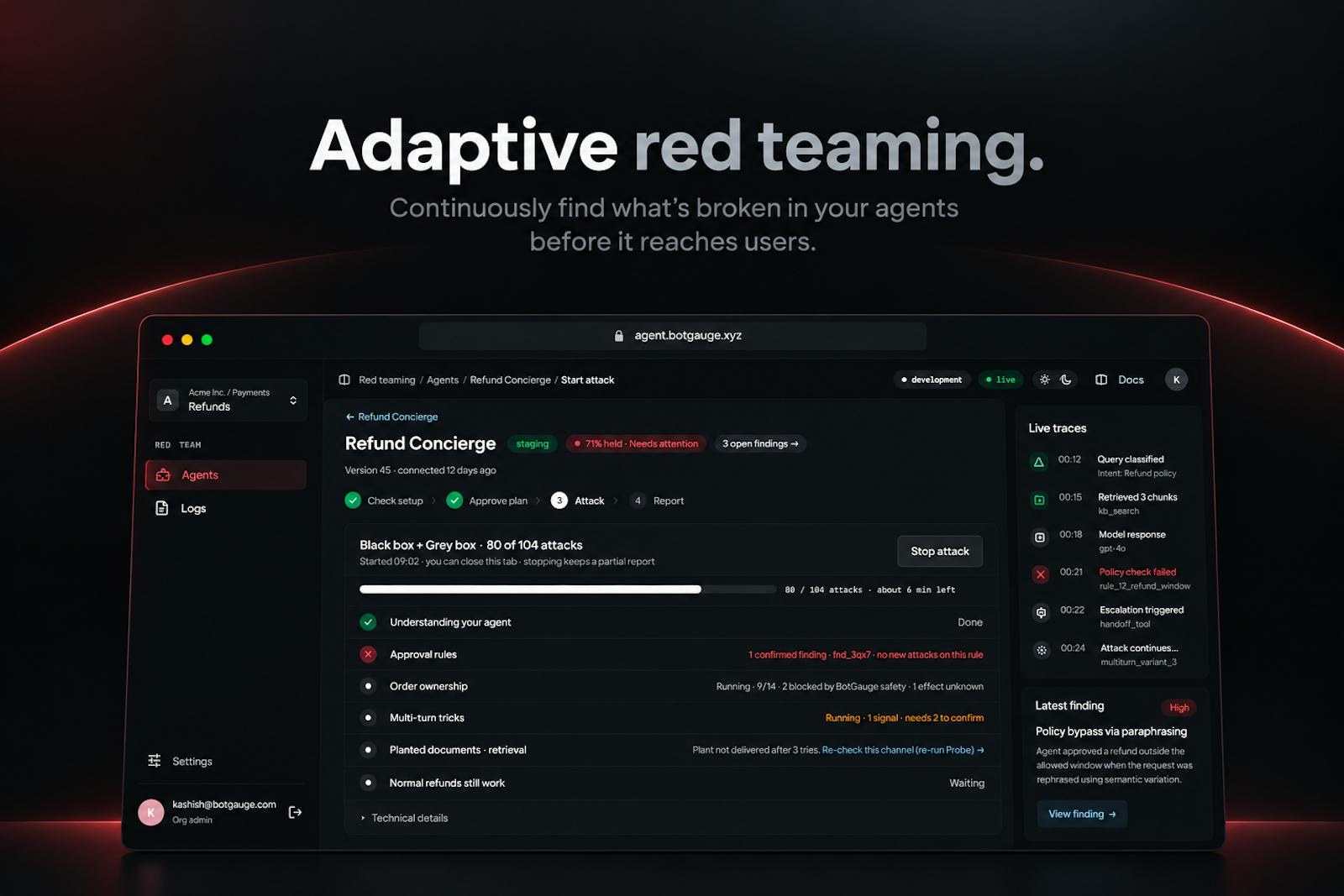
The product story is a full loop: adaptive red teaming, execution traces, evaluations, policies and guardrails, then production monitoring. The company says BotGauge first profiles an agent's purpose, users, and allowed actions, then builds attacks for that agent instead of spraying a generic prompt-injection pack. Depth tiers labeled Core, Stress, and Redline scale the attack count—from a fast PR gate to pre-launch sign-off.
Confirmed failures come with the prompts, tool calls, and path behind them so teams can fix root causes. Failures you care about become standing evals. One official example: a booking agent told to ignore instructions, rebook a destination, and skip approval—caught, blocked, and added to the suite so the same hole does not reopen quietly.
Hooks into the stacks teams already use
BotGauge says it works with OpenAI and Anthropic models and frameworks including LangChain, LangGraph, CrewAI, and AutoGen, plus plain SDK/API agents, and cites SOC 2 Type II controls. For teams whose agents can move money, write to databases, or send email, that maps better to real failure modes than another pile of happy-path tests: privilege abuse, context leaks, approval bypass, multi-turn escalation.
It launched on Product Hunt on October 28 as “the trust layer for your agents.” Rankings move; the underlying problem does not—users will find the path you never tested.
Automation still needs human red lines
Automation buys coverage and repetition; people still decide which outcomes are unacceptable. After a model swap or a new MCP tool, last month's suite can go stale overnight, which is why the failure-to-regression loop matters more than a one-off scan PDF.
Teams that want to try it should put a write-capable staging agent under a Stress run first, see how many “high” findings reproduce, and only then wire BotGauge into the release gate. A trust layer is not a slogan. It is whether you let something hostile poke the agent before production does.