
Bob Pettit, basketball great who was named the NBA’s first MVP, dies at 93
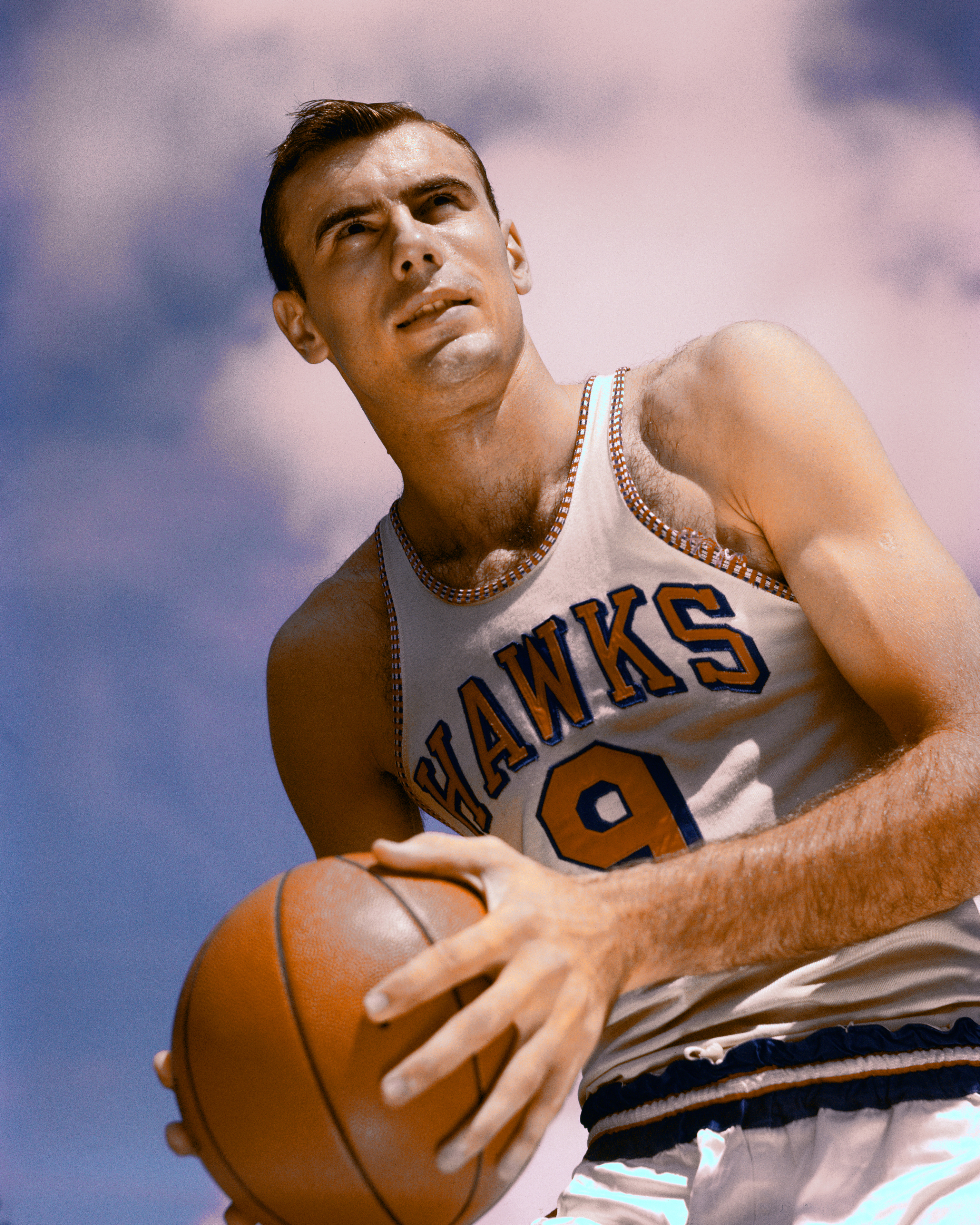
He led the St.
Louis Hawks to the 1958 title and revolutionized his position, establishing himself as one of the greatest players of his generation. He led the St. Louis Hawks to the 1958 title and revolutionized his position, establishing himself as one of the greatest players of his generation. Bob Pettit, a Hall of Fame basketball player who led the old St.
Louis Hawks to the 1958 NBA championship and helped define the position of power forward with his prolific scoring and powerful rebounding, died Sept. 23. He was 93. His death was announced by his alma mater, Louisiana State University. Before such stars as Larry Bird, Karl Malone and Kevin Garnett came to personify the modern power forward, Mr.
Pettit was the player, with his rebounding prowess and deft shooting touch, who was credited with elevating the position to a game-changing level. He was an NBA All Star in each of his 11 seasons and was the league’s most valuable player in 1956, the year the award was created. He won the MVP award again in 1959, was the first NBA player to score 20,000 points and was inducted into the Hall of Fame in 1971.
He was named to the NBA’s 50 Greatest Players list in 1996 and to its 75th anniversary team in 2021. In the era well before professional athletes were paid a king’s ransom to play, Mr. Pettit retired from basketball and became a banker in his native Baton Rouge.
In those days, players needed a summer job to make ends meet, and Mr. Pettit felt his future was more secure outside the game. He had signed with the then-Milwaukee Hawks in 1954 for $11,000 a season and won the Rookie of the Year award.
Mr. Pettit was revered for his tenaciousness, combining athletic talent and pure will to become a dominant player. “Bob made ‘second effort’ a part of the sports vocabulary,” Celtics center Bill Russell, considered by many the greatest defensive center in league history, once told an interviewer. “He kept coming at you more than any man in the game.
He was always battling for position, fighting you off the boards.” When he retired in 1965, in his prime at age 32, Mr. Pettit was the top scorer in NBA history, with 20,880 points.
He was a 10-time first-team all-NBA player, led the league in scoring two times and averaged 26.4 points and 16.2 rebounds a game throughout his career. “In his day, Bob Pettit was the best power forward that there was, Elgin Baylor included,” said longtime Celtics coach Red Auerbach in “Full Court,” a 2006 book about the St.
Louis Hawks by Greg Marecek. “Pettit could do more things than Baylor, because he could play some center and he was a much stronger rebounder.” The Hawks moved to St. Louis a year after Mr. Pettit’s rookie season, and over the next few years the team would have the nucleus of a championship contender with Mr.
Pettit, Cliff Hagan and Ed Macauley. The Hawks made it to the finals four times, with Mr. Pettit emerging as the team’s transcendent star.
The annual midseason All-Star Game, which in recent years has become little more than a glitzy show for fans, was in those days a serious grudge match in which the best players from the East and West competed fiercely to win. Mr. Pettit was named All-Star Game MVP four times back when “we played for blood,” he said in a 2016 interview with the Baton Rouge Advocate.
Perhaps his finest all-star performance came in 1962, playing against both Russell and Wilt Chamberlain, when Mr. Pettit scored 25 points and pulled down 27 rebounds, winning his fourth All-Star Game MVP award. “The thing that defined me as a basketball player was my determination to succeed,” he told Louisiana Life magazine in 2009.
‘Best game I ever played’ Robert E. Lee Pettit Jr., an only child, was born in Baton Rouge on Dec. 12, 1932. His father was county sheriff and postmaster, and his mother sold real estate. An aspiring athlete, young Mr. Pettit struggled to make an impression on the court, the football field and the baseball diamond, getting cut from all three sports during his first two years at Baton Rouge High School.
Determined to earn his letter in basketball, he practiced shooting at a backyard basketball hoop for hours, perfecting his game. As a 6-foot-4 junior, he finally made the team. And having grown three inches by the time he became a senior, he transformed into an All-State center who led his high school team to a state championship in 1950.
Mr. Pettit became a national star at LSU, where he led his team to conference titles in 1953 and 1954. He was an all-American twice while averaging 27.4 points and 14.4 rebounds per game. By his senior year, he had grown to 6-foot-9, but he weighed just 200 pounds and most scouts thought he was too slight for the rugged NBA.
But Milwaukee Hawks owner Ben Kerner thought otherwise and drafted him in the first round. Unsatisfied, even after winning his first MVP award, in 1956, Mr. Pettit spent the offseason working out with a fitness instructor in Baton Rouge, lifting weights and eventually putting on 30 pounds of solid muscle.
In an eight-team league, he realized he would be pitted against the likes of Russell and Chamberlain at least a dozen times a season and he needed maximum strength to compete. The Hawks made the NBA Finals in 1957 against the powerhouse Celtics and surprised the pundits by forcing a seventh game to decide the title. In a double-overtime thriller, the Celtics prevailed.
The next season, the two teams battled in the Finals again, and when Russell turned an ankle in Game 3, the tide turned in the Hawks’ favor. Mr. Pettit poured in 50 points, including 19 of his team’s final 21 points, and grabbed 19 rebounds in Game 6 to win the franchise’s only championship, 110-109. (The Hawks would move to Atlanta in 1968.)
Mr. Pettit’s 50 points in a championship-clinching game remain an NBA record, tied by Giannis Antetokounmpo in 2021. “That was the best game I ever played,” Mr. Pettit told the New York Times in 2003.
“Especially because of what it meant.” “That was one of the greatest games, one of the greatest clutch performances in a championship in any sport, amateur or professional,” said his Hawks teammate Macauley in a 2007 interview with the St. Louis Post-Dispatch. “I have a ring because of Bobby.”
Mr. Pettit had three children with Carole Crowell, whom he married in 1965. She died in 2010. He later married Alma Slatten. Information on survivors was not immediately available.
When Mr. Pettit retired in 1965 to go into banking, he received congratulatory telegrams from Auerbach and President Lyndon B. Johnson, among others. In 1988, he formed a financial consulting firm in New Orleans. “In those days, every player knew he had to do something after basketball,” Mr.
Pettit told the Times in 2003. “You didn’t make enough money to retire and not work. That’s why I was anxious to get involved in banking. I never wanted to coach. Once I quit basketball, I shut the door and never looked back.”
In 2016, LSU installed a statue of Mr. Pettit outside the team’s arena. At the unveiling ceremony, a humbled Mr. Pettit recalled that he had only wanted to earn a letter on his high school basketball team, and “now, here I am all these years later with a statue next door to Shaquille O’Neal,” a fellow LSU basketball star.
“Did I ever dream it? No, never.”