Devin Security Threats: One-Click Scans and Fix PRs for New Vulns
Devin Security Threats: a managed vuln index with one-click Devin scans and fix PRs.
Starts with Java4Shell and NGINX2Root; teams can add threats and auto-scan.
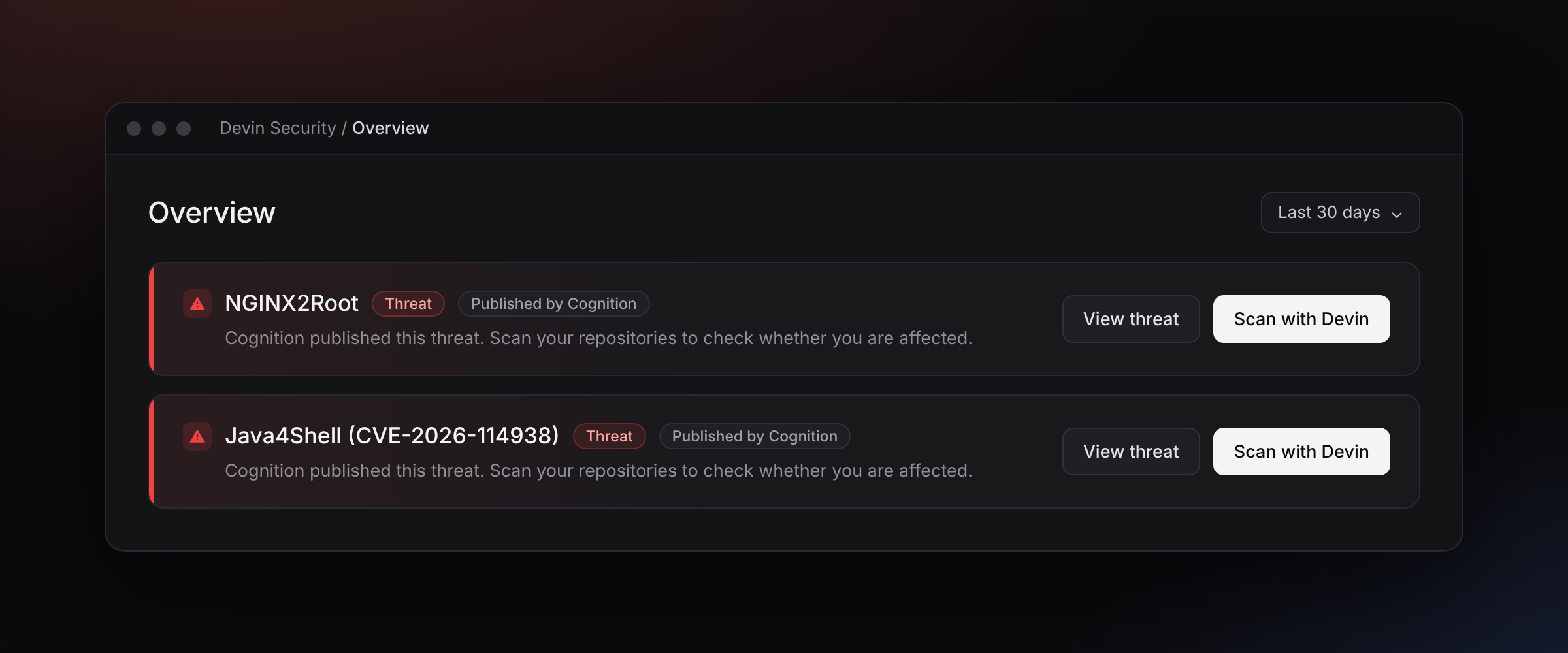
Cognition just gave Devin Security a vulnerability index an agent can act on: when a major disclosure lands, Devin can scan your repos and open fix PRs. The official Cognition account announced Devin Security Threats at 05:33 Beijing time on November 20. The company blog is dated November 18. The feature is live at app.devin.ai/security, starting with Java4Shell and NGINX2Root, both disclosed this week.
This is not a new model, and it is not unattended production patching. It is a managed threat index inside Devin Security, not a model upgrade and not a public CVE database for the open internet. Officially, the repos are scanned with the same Agentic MapReduce process used for other Devin Security scans. Findings are ranked against your threat model. You assign them to Devin, and it opens pull requests for your team to review.
Cognition's own description of the two starter threats is specific. Java4Shell, published November 17, is a vulnerability in the Java runtime that can lead to memory disclosure and remote code execution. NGINX2Root, published November 18, is a set of five memory-corruption bugs in nginx that can also lead to remote code execution. The product problem Threats is aimed at is the gap after a foundational-software disclosure: security teams still have to turn an advisory into a scan they can actually run.
A threat is an executable brief, not another firehose
Officially, a threat is a description of what could go wrong in your systems: what is affected, how an attacker would use it, and what fixes it. Cognition publishes threats for major disclosures like these two, and your team can add its own. A bug-bounty report, a vendor notice, or an incident review can become a threat the same way, as long as you give it a title and describe what could happen and how. The index is not limited to the items Cognition publishes.
Scan with Devin opens a new scan with the threat already selected under Focus on threats. You choose the repositories. Once findings appear, you can assign them to Devin, which opens pull requests for review. Auto-triage is optional, not a silent default. You pick the repositories and a minimum severity, and Devin scans them for each new threat as it is published. You can also choose to have a threat dismissed automatically if its scan finds nothing.
If you would rather run the fix as a Devin session than as a scan, the Vulnerability Fixes plugin now has a skill for each of these: fix-nginx-vuln for the five NGINX2Root bugs, and fix-java-vuln for Java4Shell. Install it from the Devin Marketplace, or from the CLI with devin plugins install CognitionAI/devin-marketplace#plugins/devin-vuln-fixes. Cognition says the skills are plain Markdown and open source, so they can also be read as a checklist or handed to another coding agent.

What auto-follows is the next threat, not an unreviewed patch pipeline
The pitch is that an advisory becomes a job an agent can start. The value still hangs on two things: how quickly and accurately Cognition covers the disclosures that matter, and whether the scans and fix PRs hold up in your own repositories — false positives, missed issues, or patches that break the build. There is no public detection or fix-success table. A threat-card screenshot is not a substitute for running it on a real codebase.
Auto-triage deserves a separate look. Turn it on, and every new threat is scanned against the repos and severity floor you set. If you also auto-dismiss threats whose scan finds nothing, you are treating a clean result as something that can be filed away. That is a policy choice, not a switch to flip by default. Whether the path is a scan or a skill session, the output is still a pull request for humans to review, not a merge to trunk.
Devin Security Threats is built for the hours after a high-volume disclosure. What Cognition shipped is not a new model name. It is a vulnerability index an agent can follow, with a boundary written in plainly: one click can start the scan and the fix, and review stays with the team.