NVIDIA Open-Sources Nemotron 3.5 Transcribe: Transcription, Speaker Labels and Translation in One Model

NVIDIA has released Nemotron 3.5 Transcribe, an open-weight speech model with about 30B total and 4B active parameters that handles 40-language transcription, speaker attribution and translation in one checkpoint, with prompt-based control over terminology.
Weights are on Hugging Face.
Teams building meeting notes, call-center QA or medical dictation often chain several models together: transcribe first, then label speakers, then translate or summarize. NVIDIA's pitch with its latest release is to do all of that in one.
The company has released Nemotron 3.5 Transcribe, an open-weight model built on a mixture-of-experts design, with roughly 30B total parameters and about 4B active per token. The weights are on Hugging Face.
One checkpoint, several jobs
According to NVIDIA, the model transcribes 40 languages, translates 31 of them to or from English, and attributes speakers in 13. It handles recordings up to an hour and labels up to eight speakers. More usefully, you steer it in plain language: "transcribe and label each speaker," "translate this into English," or even "what decisions were made in this meeting?"
For unfamiliar vocabulary, you can list terms in the prompt. In a medical setting, for example, you can supply HbA1c and metformin and tell the model to use them only when the audio supports it.
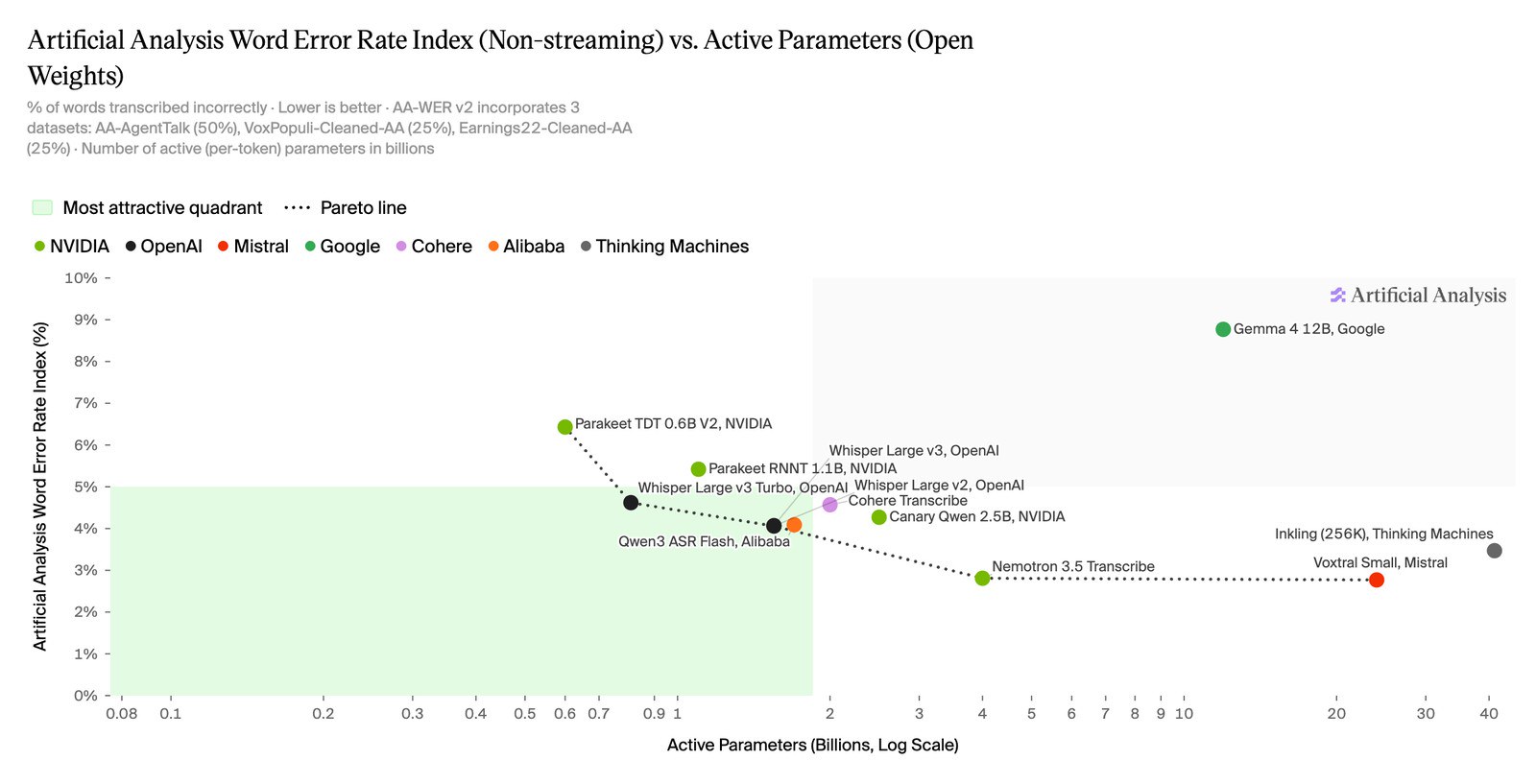
Topping the chart with a small footprint
The headline is efficiency. On the Artificial Analysis speech-to-text leaderboard it ties for first among open-weight models at 2.8% AA-WER, and the model it ties with has 24B active parameters to its roughly 4B. NVIDIA also says it scores 1.8% WER on AA-AgentTalk, the voice-agent test set, against 2.3% for the next-best open model. On speaker attribution it posts the lowest error rate on David AI's 21-language leaderboard and ranks first in VoiceArena's 14-system comparison.
Those are third-party leaderboards cited by NVIDIA, so your own recordings remain the real test: accents, noise and domain jargon all change the picture. NVIDIA itself advises spot-checking names, speaker changes and answers against the audio.
Who it fits, and who it doesn't
It is built for recorded audio, not live streaming. NVIDIA points to a single 80 GB H100 for deployment, with quantized versions promised later. If you would rather not self-host, Baseten and DeepInfra already offer hosted endpoints.
For developers working on meetings, podcasts or call analytics, it is worth running on real recordings first. If one model can replace a three-stage pipeline, maintenance costs drop in a very practical way.