
Ant Ling Opens LingSante-3.1-flash: 560B Medical MoE, HBP 65.72
Ant Ling open-weights LingSante-3.1-flash (560B/25B, MIT).
Vendor HBP 65.72, HLE 72.22, BrowseComp 94.10; behavior mean trails Astra. Not a medical device.
This is a follow-up report. LingSante-3.1-flash FP8 weights appeared on Hugging Face on November 19, 2026 (Beijing time).
On 22 November, Ant Ling officially open-weighted LingSante-3.1-flash, a healthcare MoE built on Ling-3.1-flash: 560B total parameters, 25B active per token, MIT license, weights on Hugging Face and ModelScope, plus an MXFP4 quantized checkpoint. The launch post frames three capabilities—complex medical reasoning, long-horizon workflow execution, and professional-behavior alignment—while saying general capabilities are retained.
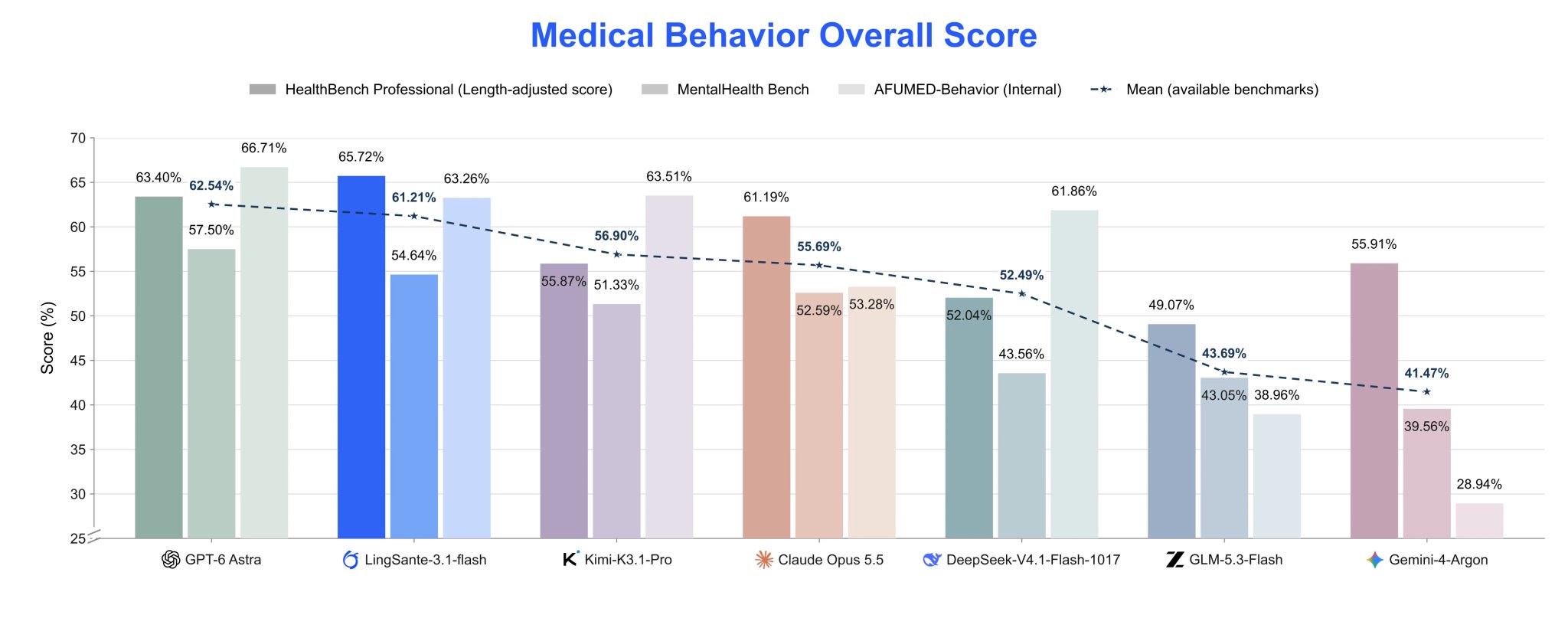
Kill the easiest misread first. On the official chart, HealthBench Professional 65.72, tool-using HLE (text-only) 72.22, and BrowseComp (with context) 94.10 all sit above GPT-6 Astra, Claude Opus 5.5, and Gemini 4 Argon in the same figure. That is not a sweep. On the same chart, MedXpertQA-Text, several internal diagnosis columns, and MCP-Atlas still favor Astra, Argon, or Opus. On Ant Ling’s own three-benchmark medical-behavior mean, LingSante-3.1-flash scores 61.21, second to GPT-6 Astra at 62.54. These are vendor launch numbers, not an independent AA or LMSYS board.
The timeline also matters. inclusionAI’s FP8 Hugging Face repo was created at 12:30 Beijing time on 19 November; the MXFP4 repo landed at 11:19 Beijing time on 22 November; Ant Ling’s official X post only arrived at 23:22 that night. That post is the announcement, not the first appearance of the weights.
Three things not to conflate
LingSante-3.1-flash is not Ling-3.2-flash. 3.2-flash is the same 560B/25B class, but a native multimodal flash that shipped without open weights. This release sits on the Ling-3.1-flash text / hybrid-reasoning base, specializes it for medicine, and actually drops the weights. The prior healthcare model, Ling-3.0-flash-Sante, was 124B total with 5.1B active per token—different scale, and the name moved from “flash-Sante” to “LingSante.”
The card’s 1M context is not the number in the repo config. The model card claims a 1M-token window; config.json sets max_position_embeddings to 262144 (256K). The architecture matches 3.1-flash: a hybrid-linear MoE, 63 KDA + 9 Gated MLA layers (7:1), 4 dense layers, 512 routed experts with 8 active per token, plus one shared expert. Whether you provision for the marketed 1M window or the 256K config field is a check you should make before serving.
It is not a medical device. The card is explicit: research and evaluation only; it must not be used as an independent basis for diagnosis, prescriptions, or treatment; benchmark and simulated-environment results do not establish clinical effectiveness. A strong vendor chart is not a path into clinical workflows.
Training stack: evidence, behavior, long-horizon tasks
Officially, general and medical data travel together through pretraining, mid-training, and SFT; post-training adds RL for medical reasoning, tool use, search, and professional behavior; multi-teacher on-policy distillation folds those strengths into one model.
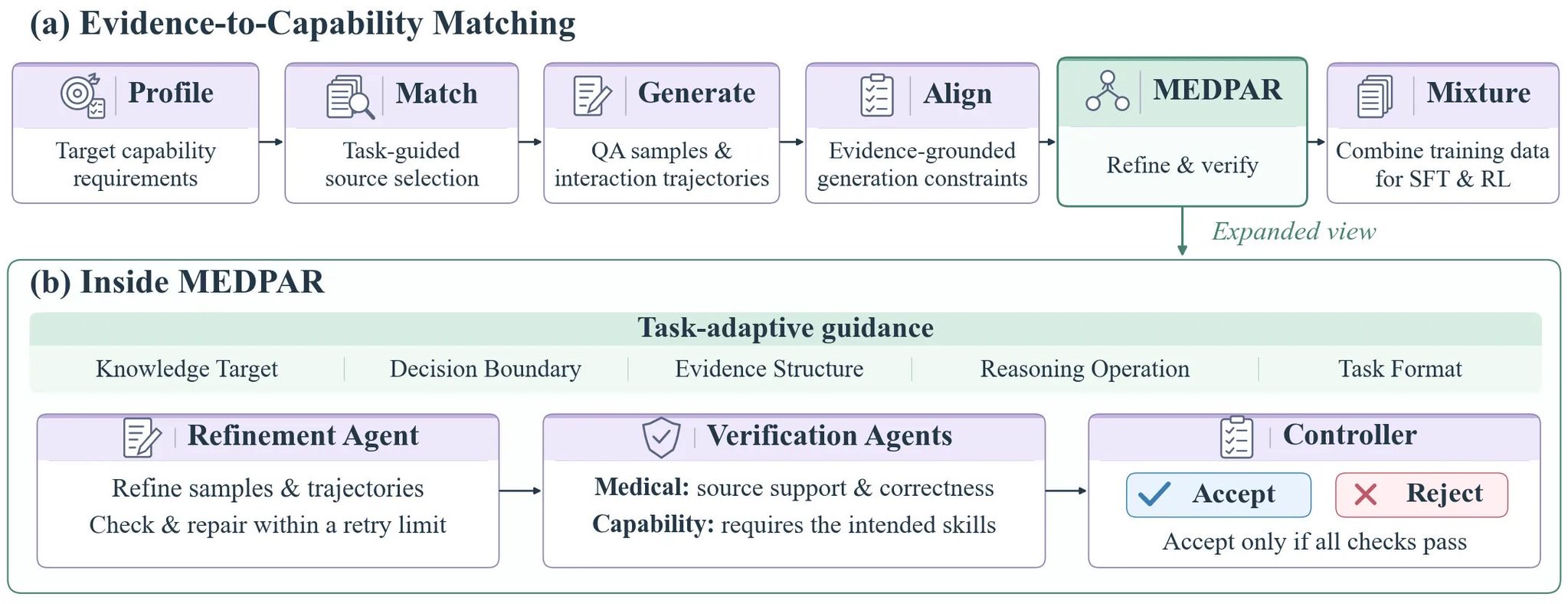
On the data side, ECM (Evidence-to-Capability Matching) maps medical evidence to capability targets, and MEDPAR runs multi-agent review so samples must pass medical correctness and task consistency before they enter training. For behavior, a behavior matrix supplies training rewards; Ant Ling says physician annotation agreement is 99.62%. For search, contribution-aware multi-agent training, versus accuracy-only multi-agent RL, is claimed to raise accuracy while cutting total search steps by more than 20%. Long-horizon tasks are synthesized across real MCP, mock MCP, and world-model environments, then checked with cross-trajectory reviews and task-level verifiers.
That is vendor methodology and in-house comparison, not a third-party reproduction. For teams who want a local medical agent, the actionable piece is open weights plus the documented SGLang / vLLM paths—not treating the launch chart as a clinical result.
How to run it, and the limits that come with it
The recommended Day-0 path is the SGLang image lmsysorg/sglang:dev-ling-3.1-flash, with MTP (NEXTN) speculative decoding. The documented recipe is 8×H200 (TP8+EP8); 4×GB300 uses TP4+EP4. vLLM configs are also published. Weights come as FP8 “originals” or the MXFP4 quantized build. For API access, Computrix is the official route: free API use of LingSante-3.1-flash requires a US$20/month Basic Token Plan; if you only use the free quota, eligible credits may be returned after the free period, subject to Computrix’s latest terms.
The close is straightforward. Ant Ling has turned its medical flash into a downloadable 560B MoE, and put high scores on HealthBench Professional, tool-using HLE, and BrowseComp on its own launch chart—while the three-benchmark medical-behavior mean still trails Astra, and the card hard-stops any reading of this as a medical device. For anyone tracking open medical models or the Ant stack, the first jobs are to reconcile the 1M marketed window with the 256K config, and to get SGLang or MXFP4 actually serving. Independent reproductions and real clinical-document workflows are what will reorder the table next.