Inkling 2 Mini: 26.4B Looped MoE That Runs on Laptops, AA Index 20.1
Thinking Machines released Inkling 2 Mini: a 26.4B looped MoE (3.4B active, 5.4B effective) for 32GB Macs, Apache 2.0 weights, AA Index 20.1.
Thinking Machines just cut its second-generation Inkling down to laptop size. At 04:10 Beijing time on November 21, the official account released Inkling 2 Mini: a 26.4B-parameter looped transformer that scores 20.1 on the Artificial Analysis Intelligence Index, with weights out under Apache 2.0. The same thread is blunt about the brief—people thought Inkling 2 Small was too big at 594B, so Mini is built to run locally.
This is not a quantized shrink of Small. The official model card describes a 24-layer decoder-only transformer with sparse MoE layers, routing each token to 8 of 128 experts. The middle 12 layers share weights and run three times per token; the first and last six run once. A single pass activates 3.4B parameters; with looping, each token lights up about 5.4B weights. Context goes to 1M tokens. Inputs are text and images; output is text. Most weights were trained and are deployed in NVFP4, with the last four layers in MXFP8. Official memory footprint is about 20GB.
Looping adds reasoning depth, not a bigger memory
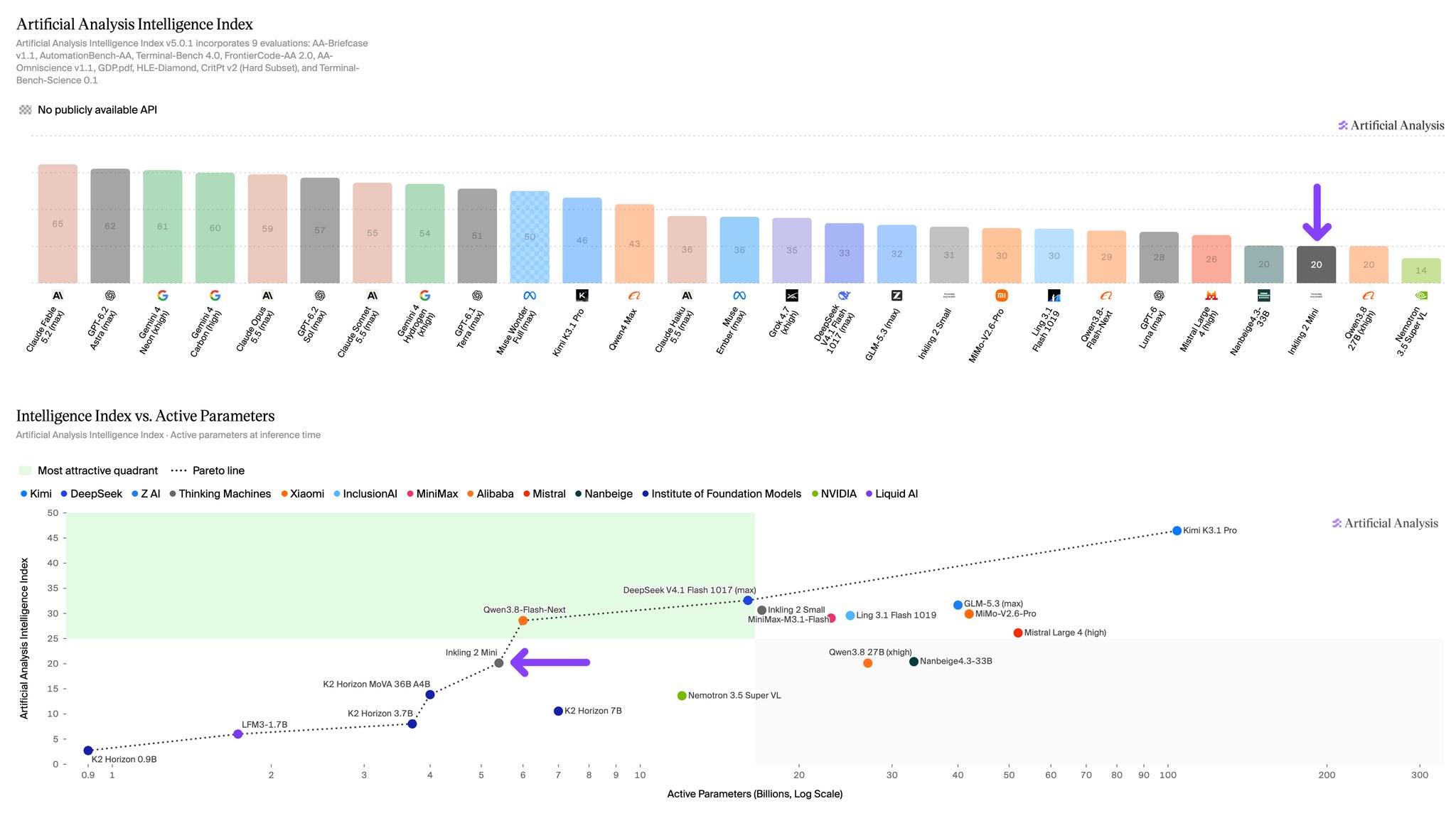
The lab’s claim is specific. Among open-weights models under 100B total parameters, Inkling 2 Mini leads on DeepSWE v1.1 at 48.2% and on Vals Index v2.2 at 46.5%. It ties Qwen3.8-27B at 20.1 on the AA Index. It also leads similarly sized open-weights models on agentic, tool-using work: 77.9% on SWE-bench Pro v2 Hard, 79.0% on BrowseComp, and 85.3% on DeepSearchQA. On the kernel-optimization benchmark PMPP-Hard, it approaches the much larger Inkling 2 Small.
Looping increases how much serial computation the model can do per token. It does not give the weights more room to store facts. Knowledge scores sit with other models of the same size; the model is meant to close that gap with search and tools. On a variable-loop research checkpoint, extra passes helped multi-hop retrieval and math and science reasoning, while closed-book factual QA barely moved.
Do not read that as a clean win over every 27B dense model. It trails Qwen3.8-27B on MultiChallenge (50.0%) and ComplexConstraints v1.1 (33.4%), and it lags larger models on hard reasoning suites such as CritPt and HLE-Diamond. The lab’s own limits list is equally concrete: Chinese output can come out clipped or mixed with English; an agent may delete or overwrite files without asking, and may not report what it actually did; debugging can stall in repetitive self-checks. Setting reasoning effort to the minimum does not turn off the three passes through the middle layers.
32GB is the official local bar; Ollama is still a pre-release
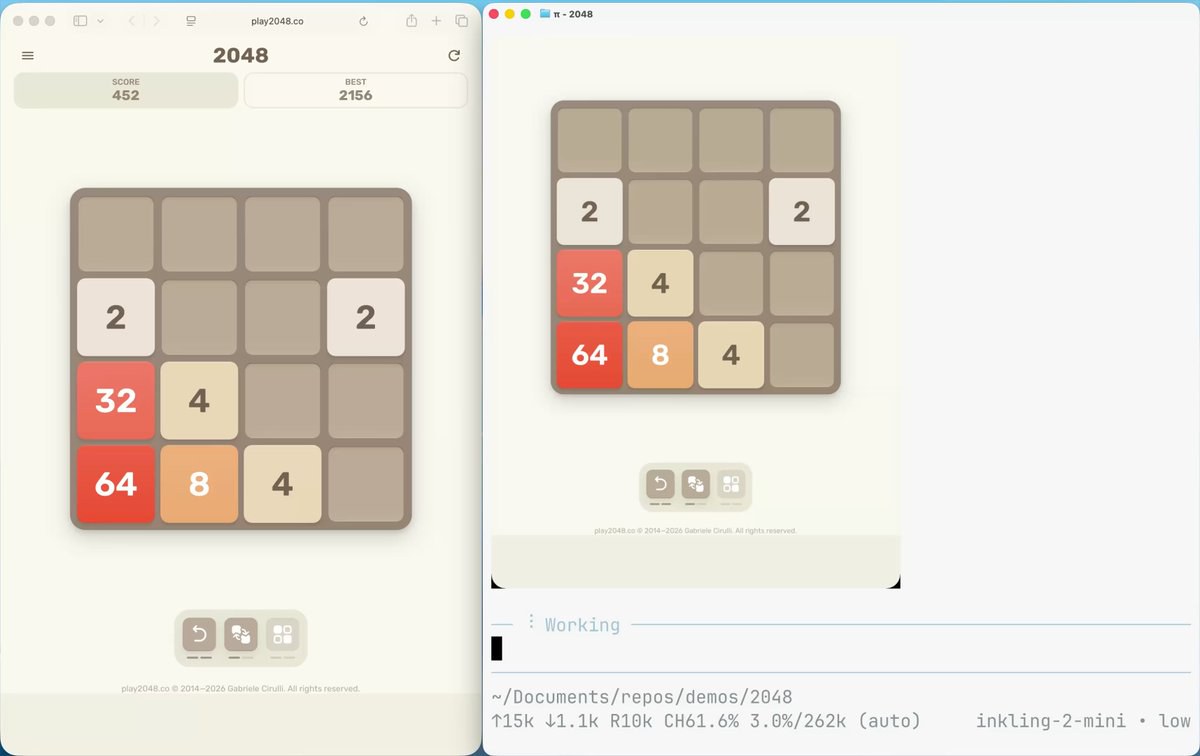
Weights are on Hugging Face. Tinker already offers inference and fine-tuning, plus chat in the Tinker Playground. The official local paths are Macs with 32GB of RAM through Ollama, and NVIDIA’s DGX Spark. At 05:21, Ollama said Inkling 2 Mini is in the 0.40.17 pre-release, and its demo shows inkling-2-mini editing a 2048 page on-device. Day-0 open-source serving is up on vLLM, SGLang, Unsloth, NVIDIA Dynamo, and TokenSpeed; RL fine-tuning is supported on SkyRL, Miles, and NVIDIA AutoModel. Researchers also took the model on a flight, ran it offline on a 48GB MacBook Pro M5 Pro, and built a playable flight simulator.
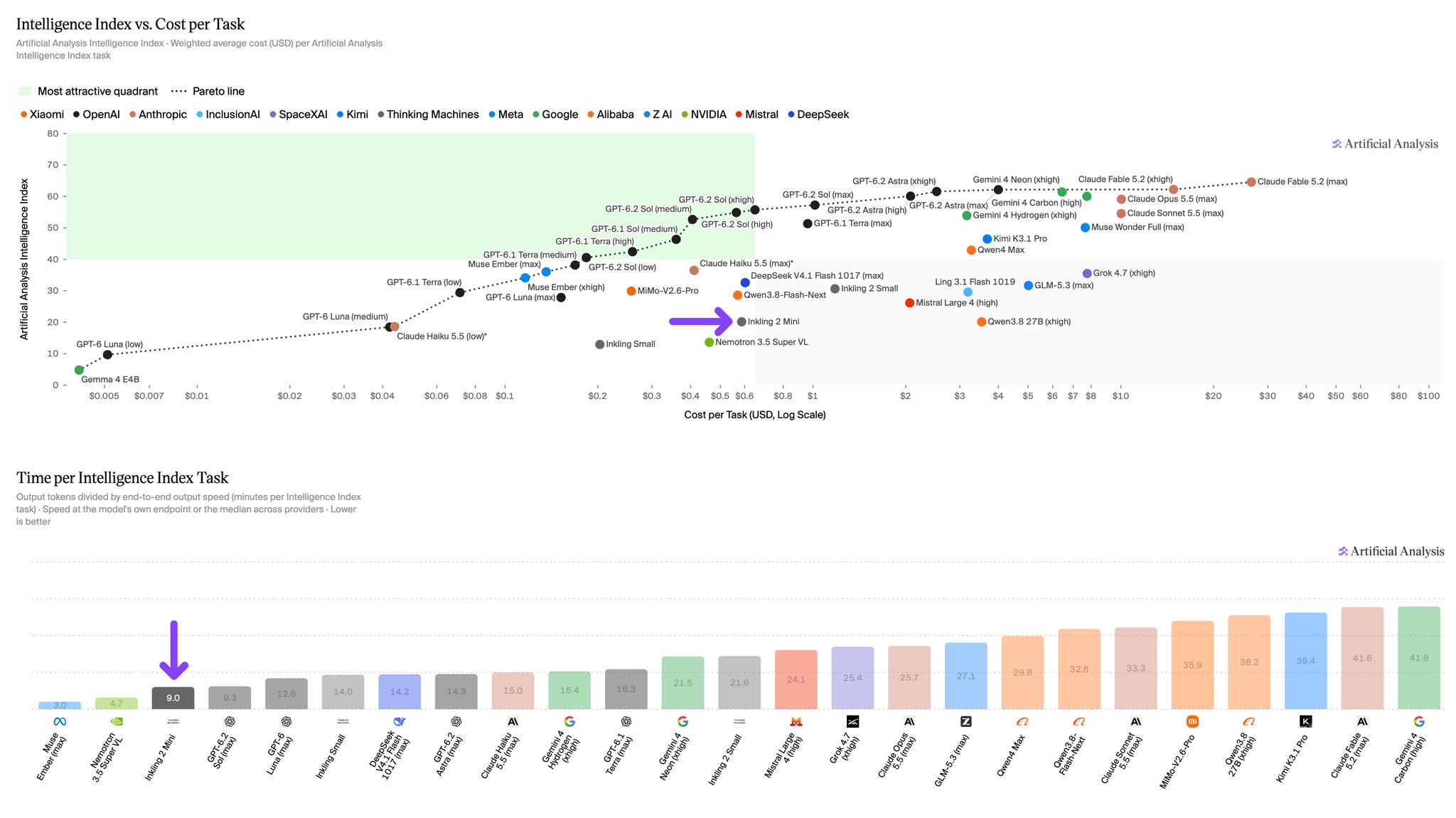
Two easy misreads are worth shutting down. Ollama’s build is a pre-release, not a stable cut. 32GB is the official Mac floor; the in-flight demo used 48GB, which is not evidence that a 16GB machine will do. Artificial Analysis’s task-level numbers, using Thinking Machines’ first-party prices, put Mini at 9.0 minutes and $0.59 per Intelligence Index task, against 38.2 minutes and $3.53 for tied Qwen3.8-27B. It emits about 38% more output tokens and uses about 2.8× less compute.
At this scale the chain of thought got shorter, not unreadable
The real argument around looped transformers is not the leaderboard. A model that can think for extra passes inside the network does not have to write that work into its chain of thought, which is what a CoT monitor can read. The lab tested monitorability as part of the release and also published a variable-loop research model, TML-d24-varloop-research, that can be run at one to five passes.
At this scale, the no-CoT time horizon rose from 16 seconds at one pass to 37 seconds at three. Chains of thought got shorter but stayed legible, and the lab reports no meaningful drop in monitorability. On N-Hop Lookup, a clean serial-reasoning test, accuracy kept improving out to ten loops. Mira Murati’s 04:14 quote is the caution that belongs with those results: looping lets a model think more and write less; at this scale the thought process remains monitorable, and that may not stay the case.
Inkling 2 Mini is not trying to be another 27B dense chat model. It packages looped compute, 4-bit weights, and an open license so agentic coding can leave the cluster. Tying Qwen3.8-27B on the AA Index is not the same as matching it everywhere; knowledge, multi-constraint instructions, and Chinese are still where this laptop model will break first. If you want it on-device, check for 32GB of memory, then check whether your runtime actually implements the looped layers.