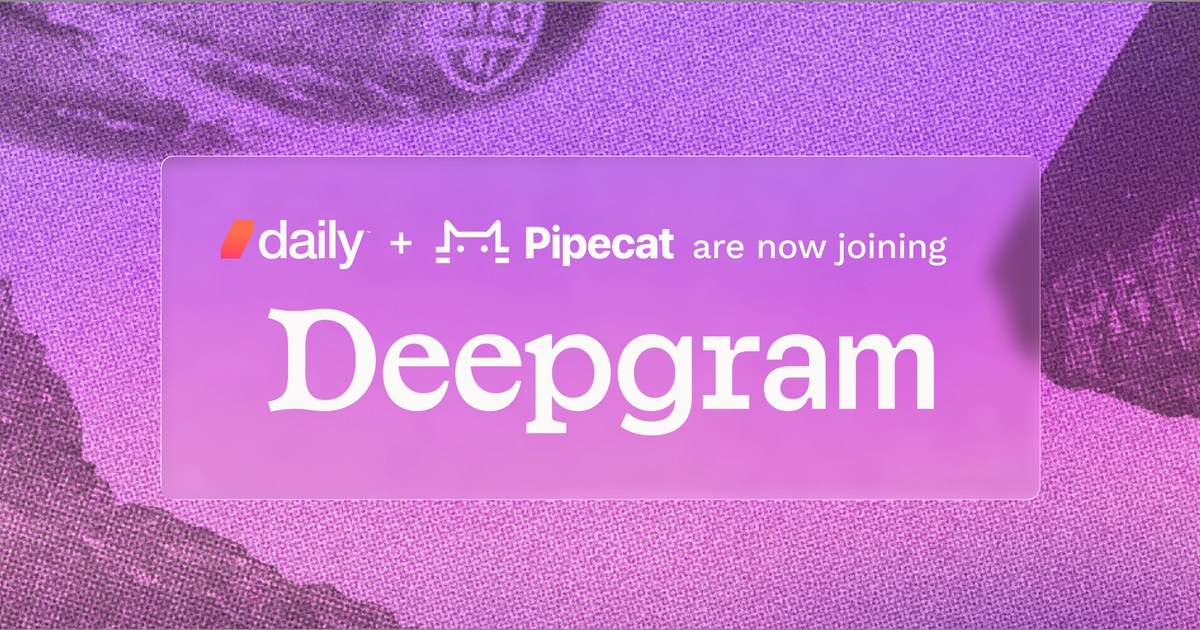
Deepgram Buys Pipecat Maker Daily as Voice AI Goes Full-Stack
Deepgram is acquiring Daily, maker of Pipecat.
The voice-agent framework stays BSD open source under a new independent Pipecat Foundation.
Consolidation has reached voice AI. On October 29, at its first Speak conference, speech company Deepgram said it is acquiring Daily, the real-time audio and video infrastructure company behind the open-source voice agent framework Pipecat. Terms were not disclosed. The Daily team joins Deepgram, and co-founder Kwindla Hultman Kramer becomes Deepgram's head of open source.
The question everyone cared about was whether Pipecat stays open. It does. Pipecat remains free under its BSD V2 license and vendor-neutral, and the two companies, along with many contributors, are setting up an independent Pipecat Foundation. A steering committee representing the wider real-time AI ecosystem, including Deepgram's competitors, will run it.
Why Pipecat matters
If you've built a voice agent, you've probably run into Pipecat. It handles the messiest glue layer: chaining speech recognition, an LLM and speech synthesis into a pipeline, managing audio and video streams, dealing with interruptions and turn-taking, and keeping latency low enough to feel like conversation. It integrates with nearly every major model provider, telephony system and deployment environment, and it is the most widely used orchestration layer for production voice AI.
Daily supplies the network underneath: 75 points of presence worldwide, tuned for the latency and reliability that live AI needs. In a voice conversation, a few hundred milliseconds decides whether it feels like talking to a person or to a laggy machine.
Deepgram fills out the stack
Deepgram's strength has been its speech recognition and synthesis models. With Daily, it owns three layers, models, real-time transport and orchestration, and can pitch a complete, open, production-grade voice platform. Pipecat becomes the core of Deepgram's new Voice Agent Platform. Deepgram also introduced the Real-Time Context Standard (RCS), an open protocol co-developed with the Pipecat team that carries audio context, such as tone or a whisper, across model handoffs, along with guidance on how a response should sound.
It's a smart play. Standalone speech recognition is getting squeezed by end-to-end options such as OpenAI's real-time API and Google's native audio models. Instead of fighting the giants model for model, Deepgram is taking the layer where developers actually assemble systems. Whoever owns the orchestration framework influences the dropdown where developers pick their default model.
How far the open-source promise goes
The community's worry is reasonable: open-source projects bought by companies often end up open in name but tilted in practice. An independent foundation with competitors on the steering committee is a fairly serious structural safeguard. The thing to watch is whether Pipecat's integrations with other vendors' models quietly fall behind Deepgram's own.
Either way, the signal is clear. Voice AI is moving from a contest of models to a contest of platforms, and consolidation at the infrastructure layer has only just begun.