ElevenLabs Scribe v3 Cuts Word Errors 27%, Live Adds Speaker Labels
ElevenLabs released Scribe v3 and Scribe v3 Live. v3 cuts word errors 27% versus v2 across 102 languages; Live cuts semantic error 43% and adds speaker labels.
ElevenLabs has released two new speech-to-text models: Scribe v3 for recorded audio, and Scribe v3 Live for realtime streams. On the company's own evals, v3 cuts word error rate 27% versus Scribe v2 across 102 languages. Live cuts semantic word error 43% versus Scribe v2 Realtime, and is the first Scribe model to do speaker diarization in realtime. Existing integrations switch with a model ID: scribe_v3 or scribe_v3_live.
Those two percentages are not the same metric, and they are not a sweep of every public leaderboard. FLEURS is short, clean read speech. Crowded meetings, crosstalk, and a mid-sentence pause on a phone call sit on a separate 16-language corpus of real recordings that ElevenLabs says it will open-source.
Two models, two rulers
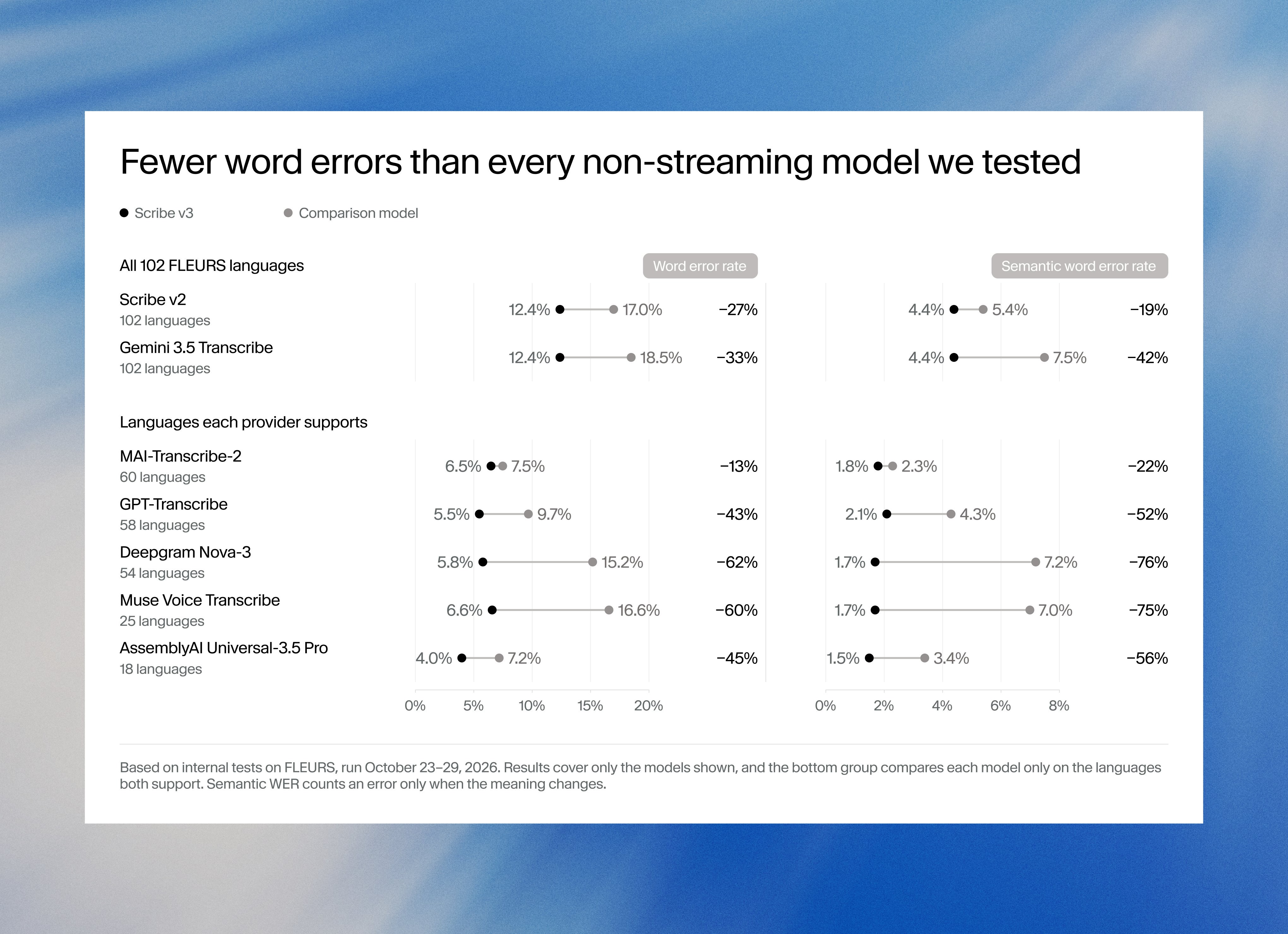
Scribe v3 is the batch model. On an internal FLEURS run across all 102 languages (October 23–29), word error rate fell from 17.0% on Scribe v2 to 12.4%, and semantic word error from 5.4% to 4.4%. Semantic WER counts an error only when the meaning changes; differences in how numbers, punctuation, or casing are written do not. Official per-language drops include German 42%, Spanish 35%, and English 23%; on harder languages, Swahili 34%, Tamil 29%, and Thai 28%. Every language tested improved.
Against "every non-streaming model we tested," the 102-language slice has only one direct peer, Gemini 3.5 Transcribe, at 18.5% WER and 7.5% semantic WER. The rest — Microsoft MAI-Transcribe-2, GPT-Transcribe, Deepgram Nova-3, Meta Muse Voice Transcribe, and AssemblyAI Universal-3.5 Pro — are compared only on the languages both sides support, a range from 60 languages down to 18. Relative cuts on that chart run from 13% to 62%. The numbers are ElevenLabs' internal tests, not a third-party replication, and the absolute rates should not be read across rows.
Scribe v3 Live is the low-latency line. On the same 102-language FLEURS set, it cuts WER versus Scribe v2 Realtime from 26.5% to 18.2% (31%) and semantic WER from 12.5% to 7.1% (43%). The largest official gains are in Greek (77%), Danish (54%), and Croatian (45%), with Hindi at 36%. Because a streaming model emits text before it has heard the full sentence, and providers format numbers and punctuation differently on the way, ElevenLabs treats semantic WER as the headline realtime comparison.
Who is speaking, and who is done
In a meeting transcript, the wrong name is as expensive as the wrong word. On ElevenLabs' own 16-language set of real meetings, agent calls, and voice notes (October 26 and November 3), Scribe v3's diarization error is 5.6% against 6.4% for Scribe v2, about 12% lower overall, and 8.0% against 9.6% on recordings with three or more speakers, about 17% lower. In the same non-streaming lineup, MAI-Transcribe-2, Muse Voice Transcribe, AssemblyAI Universal-3.5 Pro, Gemini 3.5 Transcribe, and Deepgram Nova-3 run from 8.5% to 14.2%. This is not a public benchmark; the company says the set will be released.
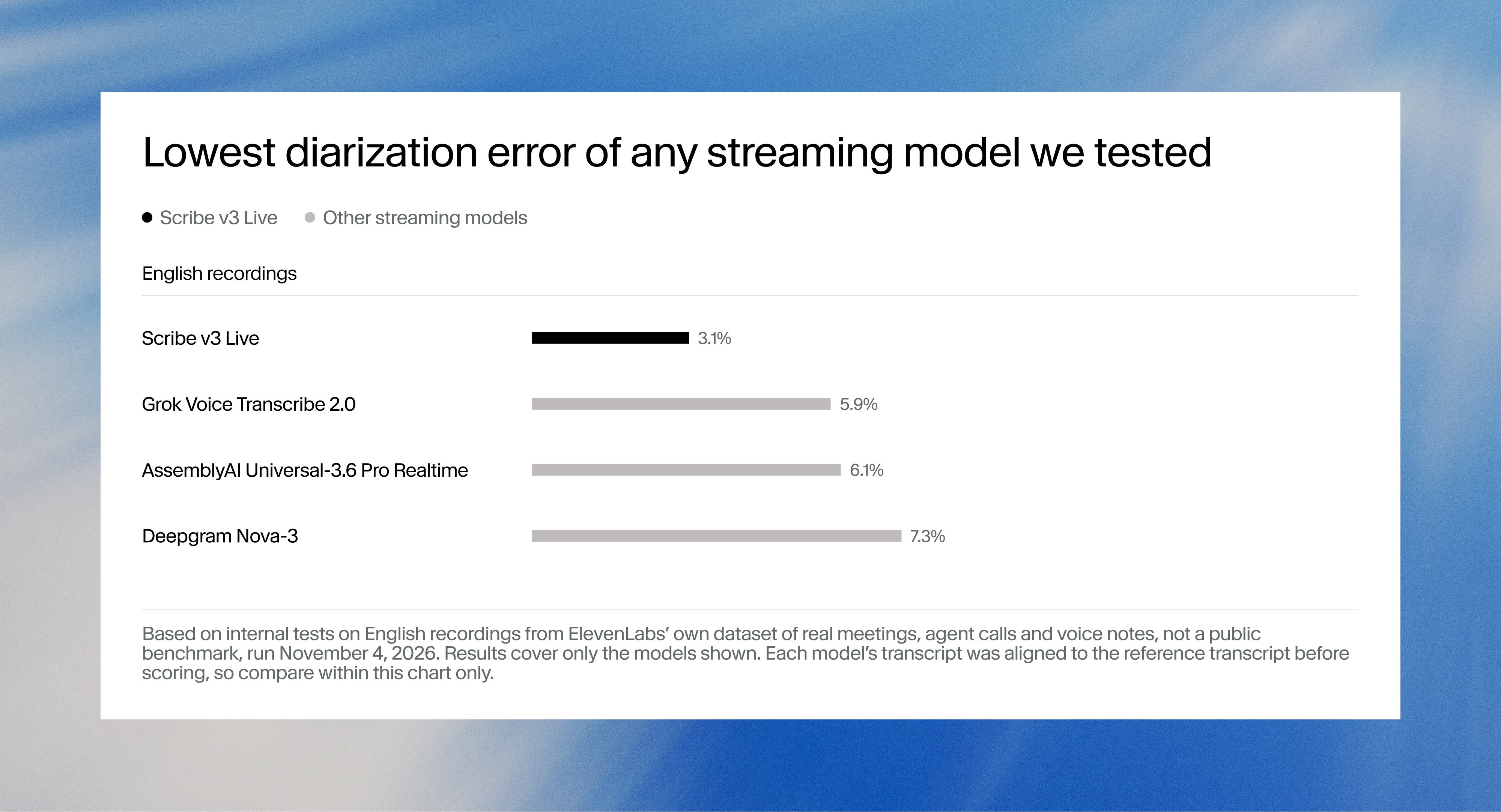
Live brings speaker labels to realtime transcription for the first time. On English real-world recordings, after each model's transcript was aligned to the reference, Scribe v3 Live scores 3.1% diarization error, against 5.9% for Grok Voice Transcribe 2.0, 6.1% for AssemblyAI Universal-3.6 Pro Realtime, and 7.3% for Deepgram Nova-3. The launch copy also says Live makes 39% fewer diarization errors than the next-best realtime model they tested — that figure is not the same scoring method as the aligned chart, and should not be divided out of the 3.1% / 5.9% pair. Alignment also lowers every model's rate, so these numbers are not comparable to the batch diarization results above.
Turn-taking is the other realtime failure mode. A silence timer that is too short cuts off a caller reading out a house number; one that is too long makes the agent feel slow. Scribe v3 Live uses conversation context as well as the audio. ElevenLabs says this is the same turn detection already used in ElevenAgents, now in ElevenAPI, via commitStrategy: "turn_prediction".
Output controls are broader too. Scribe v3 can infer which languages a recording may contain, return numbers as digits or words, and take keyterm prompts of up to 1,000 terms. Transcript edits accept plain-English rules, such as writing every date as YYYY-MM-DD. Live adds a multilingual mode for mid-sentence language switches, and a keyterm library of up to 10,000 terms — enough for a legal or medical vocabulary — consulted only when the model hears a likely match.
A few points of accuracy land on postcodes
ElevenLabs walks through the arithmetic: a one-hour meeting at 150 words per minute is about 9,000 words, so the gap between a 4% and a 2% word error rate is 180 wrong words. Diarization is scored in time; each point is 36 seconds of speech under the wrong name. Errors also cluster in names, numbers, acronyms, and jargon — exactly the tokens a summary or an agent can least afford to miss.
Eneco, which supplies energy to more than two million homes and businesses in the Netherlands, ran its ElevenAgents voice agent on Scribe v3 Live before launch. On real customer calls, Dutch postcodes were recognized correctly on the first try 40% more often, and house numbers 15% more often. A medical-optimized build of Scribe v3 Live is also going out in ElevenAgents.
The product path is already open. Scribe v3 Live is available in ElevenAgents today, Scribe v3 is the default transcriber in the ElevenLabs app, and both models are in ElevenAPI. Official docs list a 5 GB file cap, a 15-hour duration limit, and diarization for up to 32 speakers. The models run in the US by default, with isolated EU, India, and Singapore environments, plus a Zero Retention mode that deletes audio and text when a request completes. They are covered by SOC 2, ISO 27001, and PCI DSS Level 1, are HIPAA-eligible with a BAA, and are offered for private deployment.
One wrong token in the transcript is cheap. It is expensive once a summary, an agent, or a dub repeats it. Scribe v3 puts the gap at 27% and 43%. The question that actually matters is whether your audio looks like clean read speech, or like a three-person meeting and a call that changes language halfway through.
Nvdium Tech Editor