Tesla to Open Optimus Reservations, Krafton Ships Ludi 0.2, AgiBot and Tsinghua Scale Fleet Learning to 96 Robots
Tesla plans early-December Optimus reservations; Krafton's Ludo Robotics ships Ludi 0.2; Tsinghua, AgiBot and Infinigence publish CEL on a 96-robot fleet.
Nvdium Tech | October 31, 2026
Tesla plans to open Optimus customer reservations in early December
Tesla plans to open customer reservations for its Optimus humanoid in early December, the first time the public can join a waitlist. Most units are expected to go to companies, with a smaller share set aside for individuals, and the first shipments are expected to be Optimus V3. The reservation window is timed around the Humanoids Summit on December 1–2 in San Mateo, where Tesla is a key partner and plans to demo Optimus V3. Public coverage has put a consumer price north of about $20,000, though Tesla has not announced an official price or whether a deposit is required. Outside deliveries still point to late 2027: on the third-quarter call, Elon Musk said Optimus still needs work on AI, electromechanical design and runtime, and that is when he expects deliveries to companies outside Tesla. Production has already started at Fremont, with a target of about 20,000 robots a week by around the end of 2027.
Krafton's Ludo Robotics releases Ludi 0.2
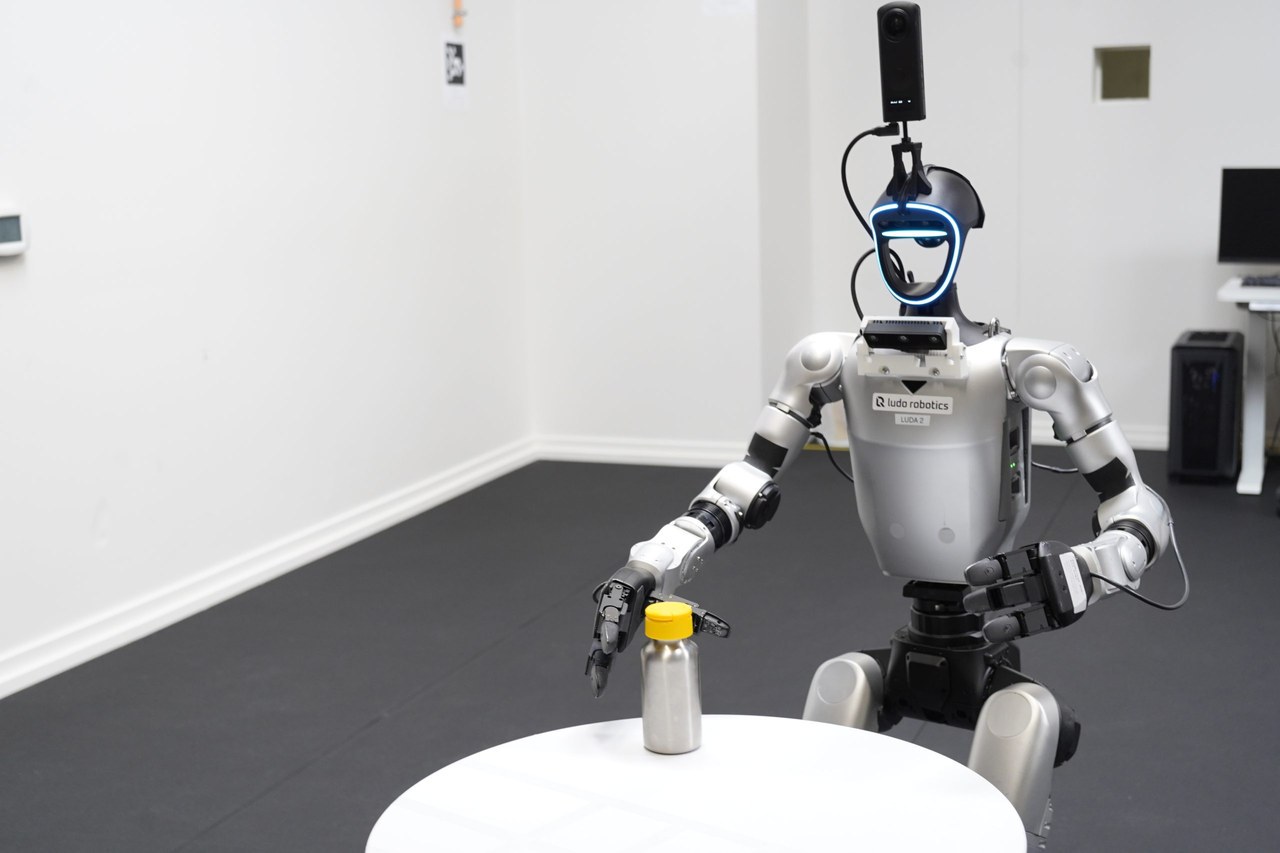
Krafton subsidiary Ludo Robotics released Ludi 0.2 and presented it at the 2026 Bay Area Robotics Symposium at UC Berkeley. The system targets more natural human–robot collaboration. Building on Ludi 0.1 from August, version 0.2 strengthens social intelligence, memory and reasoning, tool coordination, gesture interpretation and physical movement, aiming to fold conversation, reasoning and physical action into one “brain.” Ludi 0.1 combined a vision–language model for reasoning and dialogue with navigation and manipulation, so it could follow spoken instructions, keep conversational context, ask clarifying questions and switch tasks in supported settings. Ludo is based in Palo Alto with an R&D lab in Seoul; Krafton CEO CH Kim also leads Ludo, and Krafton chief AI officer Kangwook Lee is CTO. The longer roadmap is Ludi 1.0, a foundation model meant to unify perception, dialogue and physical action.
Tsinghua, AgiBot and Infinigence publish CEL across a 96-robot fleet
Tsinghua University, AgiBot and Infinigence AI introduced Collective Experience Learning (CEL), with the FERT algorithm and the fault-tolerant asynchronous training system FATS. After expert-supervised initialization, later improvement no longer depends on new teleop demonstrations or corrections. Robots run the tasks themselves: successful trajectories supply action targets, and failure clips retrieve related successful segments for higher sampling weight. Operators only label whole episodes as success or failure and reset the scene. Across five real tabletop manipulation tasks, at the largest training fleet for each task, policies reached 93.3%–99.2% success on held-out robots that never contributed training data. On multi-stage phone packaging, growing the fleet from 16 to 96 robots raised success from 86.7% to 98.3%. During the 96-robot run, local faults hit about every 22 minutes on average, yet fleet-level collection kept going, with fault-related downtime about 1.3% of total robot time.