
Axiom Math’s Agent Swarm Formalized the Classification of Finite Simple Groups in 24 Days
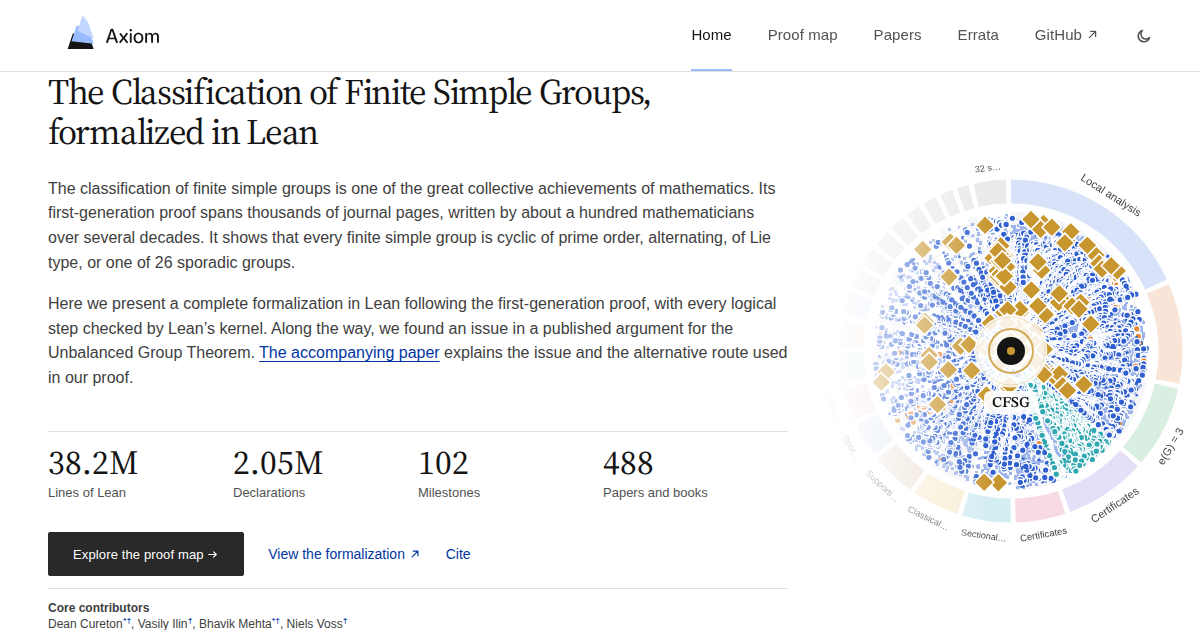
Axiom Math used AxiomProver AI-agent swarms to produce a complete Lean formalization of CFSG in about 24 days—roughly 43.1 million lines of code—and flagged multiple deviations in the published literature.
One of the longest proofs in mathematics now has a complete, machine-checked version. Axiom Math says the Classification of Finite Simple Groups (CFSG) has been fully formalized in Lean.
At a glance
What it is: a complete Lean formalization of CFSG, the classification of finite simple groups
How: engineers and mathematicians directed AxiomProver AI-agent swarms to write the proof
Scale: the human proof runs about 15,000 pages; the formalization produced roughly 43.1 million lines of Lean
Time: the company says about 24 days
Side effect: the process surfaced multiple deviations in the published literature
Turning an “enormous theorem” into checkable code
CFSG is often called the enormous theorem: it lists the building blocks of finite groups, with the human argument scattered across hundreds of papers and about 15,000 pages. Everyone relies on it; almost no one can re-check it line by line.
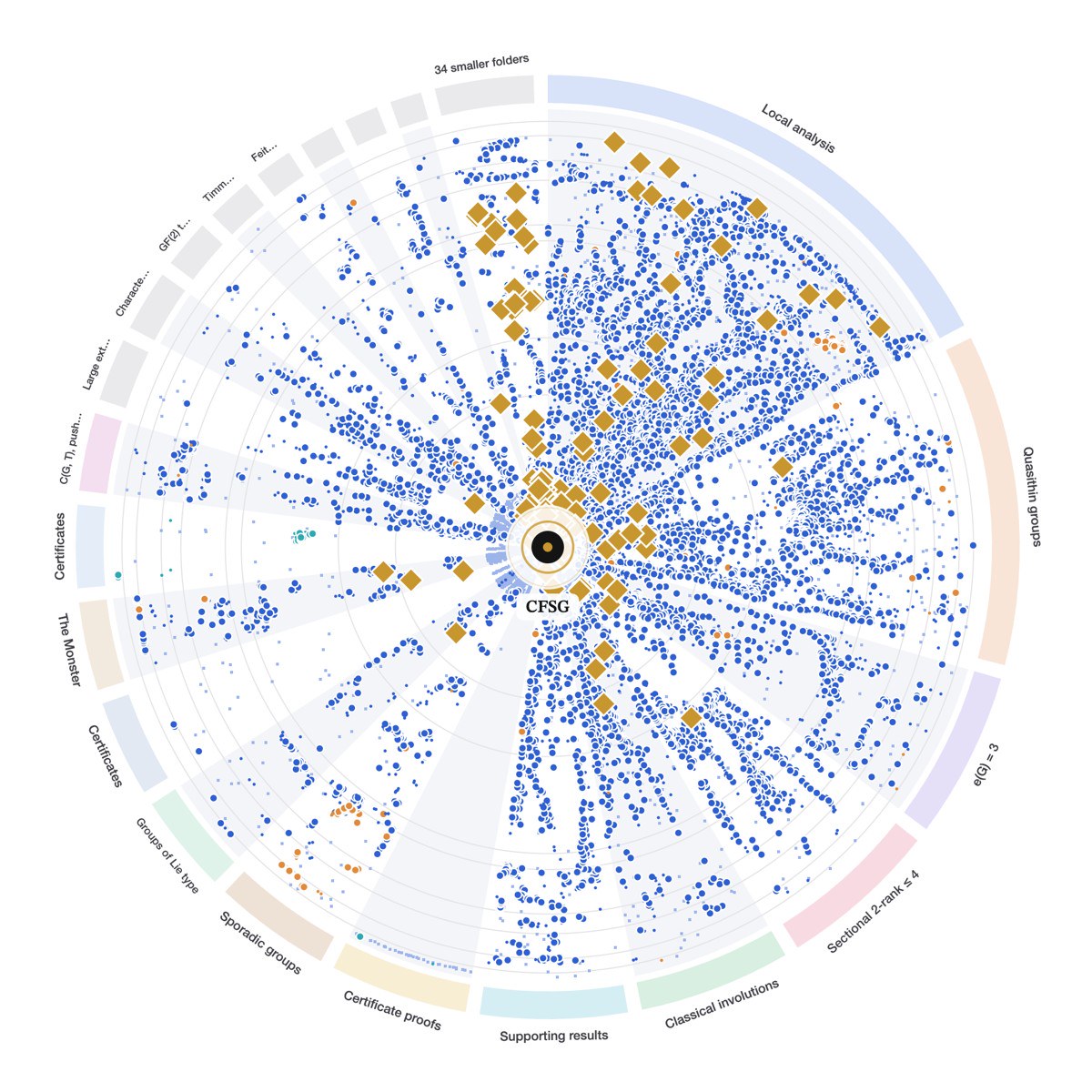
Axiom’s approach was to rewrite the argument in Lean so every definition, hypothesis, and deduction is precise enough for a computer to verify. The company says AxiomProver ran dozens of agents against a shared proof map—more than a hundred milestones and hundreds of smaller tasks—until roughly 43.1 million lines connected into a buildable proof.
Machine checking is also literature review
Formalization is not just translation. A human reader can silently fill in a missing hypothesis; Lean will not. The company says the work exposed multiple deviations in the literature—many typos, table errors, or dropped assumptions, plus more substantial gaps that needed alternative routes, including a notable issue around the Unbalanced Group Theorem.
That is the point of the exercise: turning “widely believed” into “kernel-checked.” For algebra, combinatorics, and mathematical physics that cite CFSG in a sentence, a Lean development is harder evidence than another survey paper.
Finishing the enormous theorem in 24 days took human route-setting, agent-written proofs, and a proof assistant as final referee. The release also points readers to a public repository and an interactive proof map so outsiders can inspect what was actually checked. The next question is not whether AI can write proofs, but which other century-scale results deserve the same treatment.