
India's CIIL Open-Sources Anuvani: Know the Language, Then Tell Who Is Speaking
India's Central Institute of Indian Languages has released Anuvani-LID and Anuvani-Diarization, two open speech models for Indian languages.
One identifies the spoken language and the other separates speakers, covering the 22 scheduled languages plus Indian English.
For anyone building voice products in India, the first hurdle is often not transcription but a simpler question: which language is this? The Central Institute of Indian Languages (CIIL) has open-sourced Anuvani to cover that step, and the equally basic one of working out who is speaking.
The first release has two models: Anuvani-LID identifies the spoken language, and Anuvani-Diarization works out who speaks when. CIIL says both support India's 22 scheduled languages and Indian English, and ship with research papers, open weights, on-device mobile toolkits and production kits for NVIDIA Triton Inference Server.
Language ID: a small model with one job
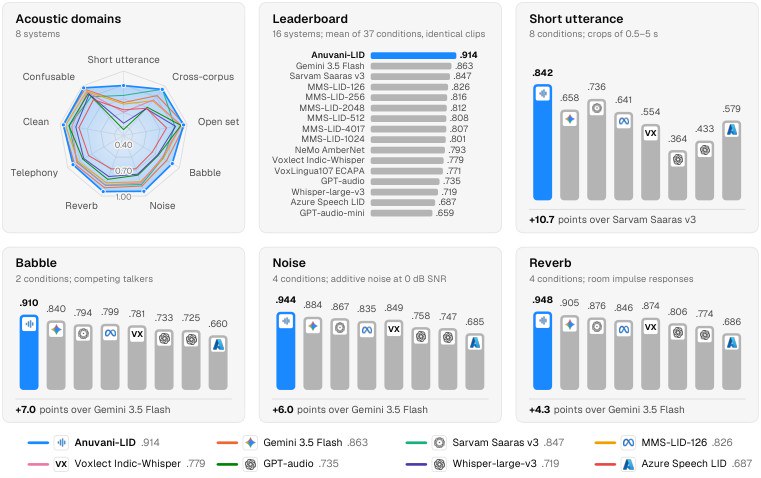
Anuvani-LID is a 115.6M-parameter Conformer trained on 54,643 hours and more than 31 million utterances of Indian speech, with 23 output labels. In the accompanying paper, the authors report a mean macro-F1 of 0.914 across 37 test conditions, 5.2 points above Gemini 3.5 Flash, and a 24-point lead on one-second clips. Its scores are calibrated, so they can be read as confidences. The model is Apache-2.0, roughly 13 times smaller than Whisper-large-v3, and comes in ONNX and sherpa-onnx versions that can run offline on a phone.
Diarization for calls and meetings
Anuvani-Diarization has about 76.1 million parameters and is designed for phone calls, meetings, large-room recordings and broadcasts, including fast speaker changes and overlapping speech. CIIL says that in a zero-shot test on IndicDiarBench, covering 1,164 recordings across all 22 languages, it reached a diarization error rate of 16.78%, the lowest of the 18 systems CIIL evaluated.
These capabilities sound modest, but they sit at the front of every multilingual speech pipeline. Language ID decides which recognizer to run and which language to translate into. Speaker separation is what makes call-center analytics, meeting notes and media monitoring useful.
The caveat is that these figures come from the research team's own evaluations, so developers will still need to test on real accents, code-mixed speech and noise. Even so, with Indian languages long underserved by general-purpose models, an openly released toolkit from a government institute is a genuinely practical building block.