
Gemini Robotics ER 2 Hits Public Preview as a High-Level Brain for Arms to Humanoids
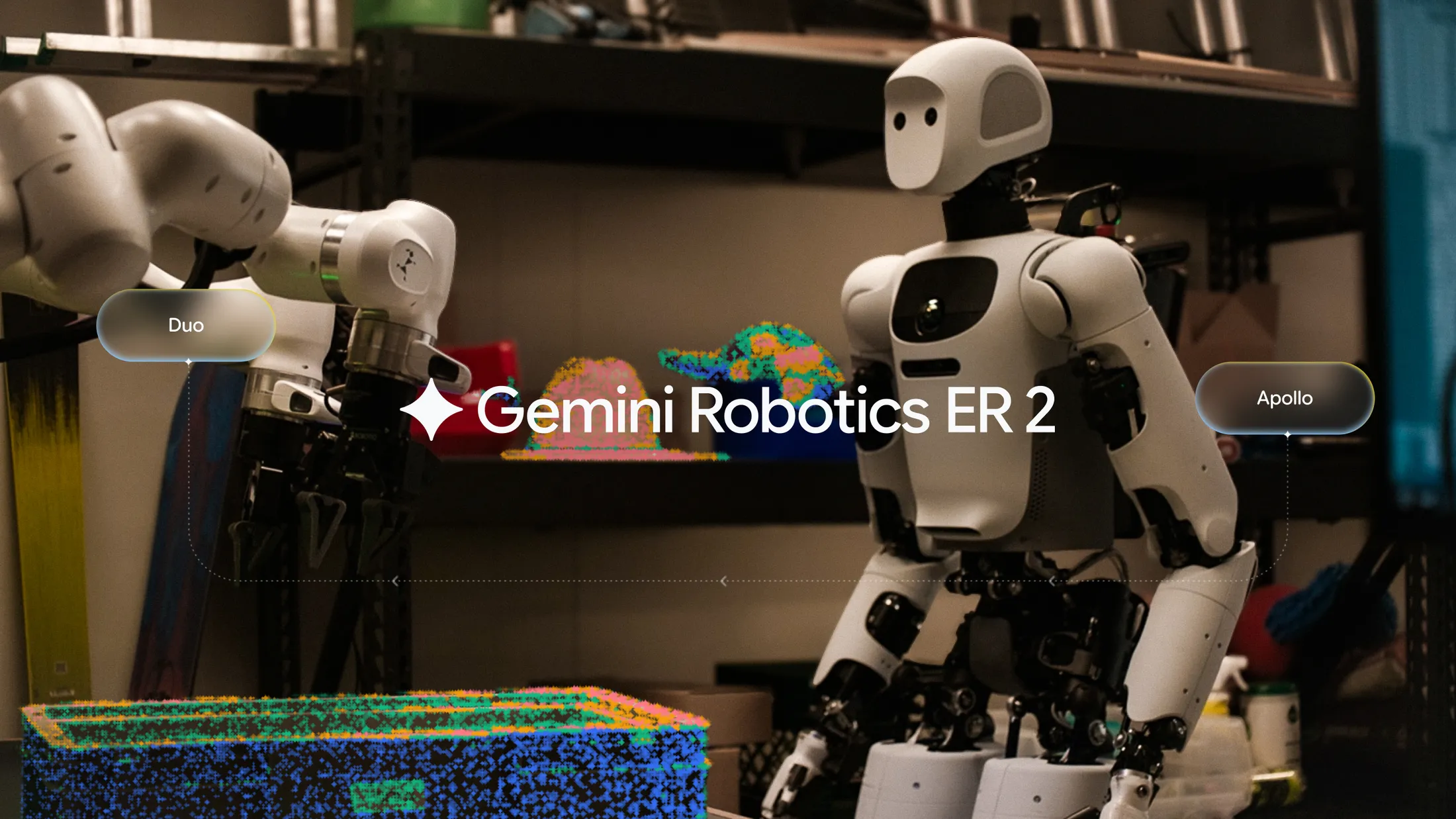
Google’s Gemini Robotics Embodied Reasoning 2 is in public preview on Google Cloud / Model Garden.
As a robot’s high-level brain, it reasons over video for spatial and progress cues, plans multi-step work, and can call low-level control and navigation APIs across embodiments from arms to humanoids.
Robots rarely fail for lack of joints. They fail for lack of a clear next step. Google has put Gemini Robotics Embodied Reasoning 2 (ER 2) into public preview on Google Cloud.
At a glance
What it is: a high-level reasoning model—a robot’s “brain”
Where: public preview via Google Cloud / Model Garden
Strengths: spatial understanding and task-progress judgment from video, plus multi-step planning
How it acts: can call low-level control, navigation APIs, and VLAs as tools
Embodiments: from stationary arms to humanoids
High-level brain, leave the fingers downstairs
ER 2’s job is to read the scene, break down the task, and track progress. Torque and grasp stay with lower-level VLAs or hardware APIs. Developers declare navigation and manipulation interfaces as tools, then stream video, audio, or text into the model so it can plan and orchestrate at once—across tasks that may run for minutes and involve many sequential decisions.
Google says the model can classify or score task progress and pin key moments in video—knowing whether a step succeeded or needs a retry. That is closer to what a factory needs than a model that only invents a motion clip.
One intelligence layer, many bodies
The company says the same reasoning layer can span fixed arms, wheeled platforms, quadrupeds, and humanoids, and can coordinate multi-robot teams that share a semantic view of the workspace and hand work off. For enterprises, that means less “one brain per machine type.”
Putting the preview in Model Garden wires DeepMind’s embodied reasoning into Cloud IAM, orchestration, and lifecycle tools that enterprises already use for other Gemini models. The open questions are sim-to-real cost and whether latency and built-in safety rails hold up when the model hammers low-level APIs on a live floor. The stack is clearly splitting into high-level reasoning plus low-level execution—and ER 2 is betting on the top layer.